Link Building Statistics for 2026: 60+ Stats You Can Actually Verify
Written ByReviewed byUpdated


On this page
- How these numbers were vetted
- The headline numbers
- Do backlinks still matter in 2026?
- What link building costs in 2026
- What's actually working: tactics in 2026
- Link quality standards
- Link building in the age of AI search
- The catch: your links don't last
- Link building by industry
- How teams manage and measure link building
- 5 link building stats you should stop citing
- What this means for your 2026 strategy
- Sources and methodology
Open any link building statistics roundup and you hit the same problem: the numbers don't trace back to anything.
You have seen the cycle. One blog cites "94% of marketers say quality beats quantity." The next blog cites the first blog. A third cites the second. Six months later that stat is on 200 pages and the original "study" turns out not to contain the number at all. I checked that exact claim while researching this piece. It is not on the page everyone attributes it to.
So I did this differently. Every statistic below was pulled from the original publisher's own report, checked against their page, and labeled with its sample size and publication date. Where a famous stat turned out to be fabricated, misattributed, or quietly seven years old, I left it out (and called a few of them out by name near the end).
That standard matters more than usual right now, because link building in 2026 is being reshaped by AI search, and the gap between what is true and what gets repeated has never been wider.
How these numbers were vetted
Three rules, applied to every stat:
- First-party only. The number had to appear on the page of the company that actually ran the study or survey. No roundups citing roundups. If the trail ended at an aggregator, the stat was cut.
- Dated and sized. Every figure carries its publication year and, where the source disclosed it, the sample size. A 2016 correlation study and a Q1 2026 survey are both useful, but you should know which one you are reading.
- Wording preserved. If a source said links "correlate with" rankings, I did not upgrade that to "cause." Small distinctions, kept intact.
The sources span Ahrefs, BuzzStream, Editorial.link, uSERP, FatJoe, Reporter Outreach, Semrush, Backlinko, Digitaloft, Google, Pew Research Center, and BrightEdge. Full citation list with links is at the bottom.
The headline numbers
If you read nothing else, read these eight.
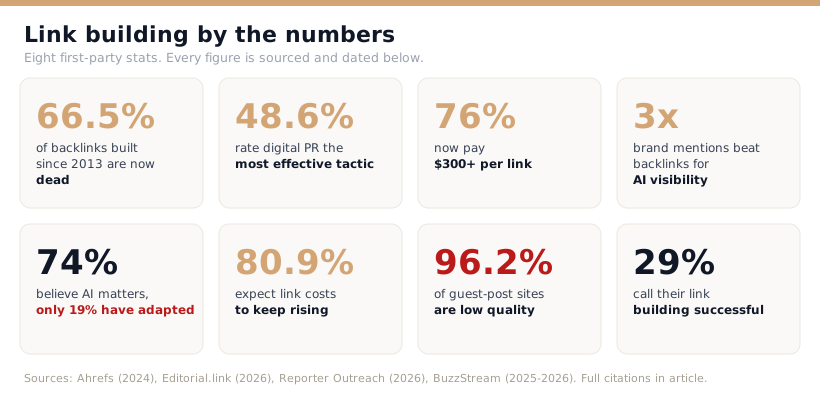
- 66.5% of all backlinks created since 2013 are now dead. (Ahrefs link rot study, 2,062,173 sites, updated February 2024.)
- 48.6% of SEOs rate digital PR the single most effective link building tactic for 2026. (Editorial.link, survey of 518 SEO professionals, March 2026.)
- 76% of practitioners now pay $300 or more per link. (Reporter Outreach, Q1 2026 survey of 500 SEO pros.)
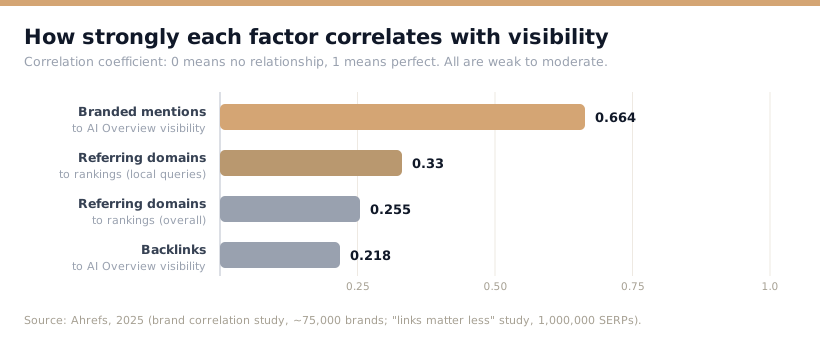
- Branded web mentions correlate with AI Overview visibility about 3x more strongly than backlinks (0.664 vs 0.218). (Ahrefs, ~75,000 brands, May 2025.)
- 74% believe backlinks affect AI search visibility, but only 19% have changed how they build links. (Reporter Outreach, 2026.)
- 80.9% of specialists expect link building costs to rise over the next two to three years. (Editorial.link, 2026.)
- 96.2% of sites on guest-post marketplaces are low quality. (BuzzStream analysis of 257,267 sites, June 2026.)
- Only 29% of teams say their link building efforts are successful. (BuzzStream Link Building Trends Report, April 2025.)
Do backlinks still matter in 2026?
Short answer from the data: yes, but less than they used to, and less than most SEOs assume.
When Ahrefs analyzed 1,000,000 SERPs in January 2025, the correlation between referring domains and rankings came out at 0.255, a positive but weak relationship. (Ahrefs, January 2025.) Links still move with rankings. They are no longer the dominant lever some 2015-era content implies.
Two findings from that same study sharpen the picture:
- Links correlate more strongly for local queries (0.33) than for searches overall. When Google has less to go on, it appears to lean harder on links. (Ahrefs, 2025.)
- The number of linking domains matters more than raw backlink count. Diversity beats volume. (Backlinko ranking study.)
The older correlation studies still get cited everywhere, and they are real, but you should know their age:
- The #1 result in Google has 3.8x more backlinks than positions 2 through 10. This is from Backlinko's analysis of 11.8 million results, originally published in 2016. (Backlinko.) Treat it as a foundational baseline, not fresh data.
- 94% of all online content gets zero external links. Backlinko and BuzzSumo, 912 million blog posts, 2019. (Backlinko.) Most pages never earn a single link, which is exactly why deliberate link building exists.
- 92.3% of domains that held a top-100 ranking for 13 straight months had at least one backlink. Semrush, 2,155 domains, March 2023. (Semrush.)
Practitioners themselves are split on how much links still matter. 67.5% of SEOs say backlinks have a "big" impact on rankings, but 64.9% also believe a site can rank highly without them. (uSERP survey of 800+ SEOs, 2025; Editorial.link, 2026.) Both can be true: links help, and they are no longer strictly required.
What link building costs in 2026
This is where the data is least ambiguous: prices are up, and almost everyone expects them to keep climbing.
Start with what a single link costs, by method, all from first-party analyses:
| Link type | Typical cost | Source (year, dataset) |
|---|---|---|
| Link insertion (niche edit) | $179 average | BuzzStream, 2026, 421,259 sites |
| Guest post, bought direct from the site | $295 average | BuzzStream, 2026, 257,267 sites |
| Guest post, bought through a vendor | $461 average | BuzzStream, 2026 |
| What SEOs say they'll pay for one quality link | $508.95 average | Editorial.link, 2026, n=518 |
| High-quality guest post (via vendor) | $3,130 average | BuzzStream, 2026 |
| Top-tier site guest post | $6,018 average | BuzzStream, 2026 |
Now the budgets behind those purchases:
- 64% of SEOs spend $3,000 or more per month on link building. 38% spend $6,000+, and 17% spend $12,000+. (Reporter Outreach, Q1 2026, n=500.)
- 76% will pay at least $300 per link; only 6% are still shopping under $100. (Reporter Outreach, 2026.)
- The average minimum monthly budget to compete in a highly competitive niche is $8,406. (Editorial.link, 2026.)
- 47% of link builders spend more than £600 per month; 14% spend more than £1,500. (FatJoe Future of Link Building survey, 536 respondents, late 2024.)
And the direction of travel:
- 80.9% of specialists believe link building will get more expensive over the next two to three years. (Editorial.link, 2026.) Reporter Outreach's separate survey put the same expectation at 75%. (Reporter Outreach, 2026.)
- 61% expect their link building spend to increase, and only 4% expect a cut. (FatJoe, late 2024.)
- 58% increased their link building budget year over year; only 14% reduced it. (Reporter Outreach, 2026.)
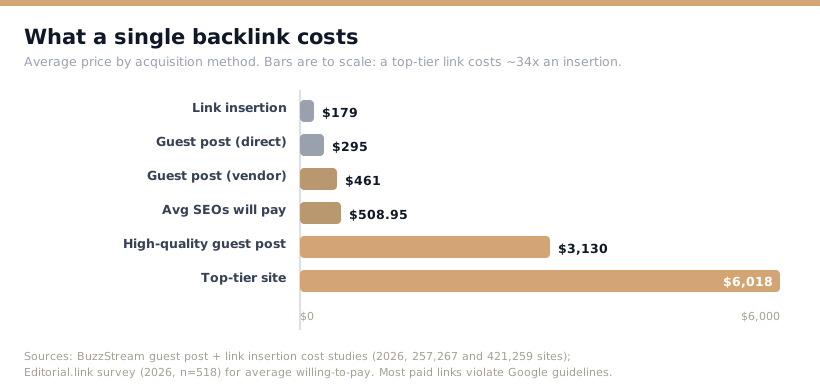
One caveat worth flagging on price: most of those purchases break Google's guidelines, which treat paid links as a violation. The data describes what the market does, not what Google endorses.
What's actually working: tactics in 2026
Every recent survey points the same direction. Digital PR has become the consensus top tactic, and guest posting has slipped from its throne.
- 48.6% of SEOs name digital PR the most effective tactic for 2026, the top choice by a wide margin. (Editorial.link, 2026.)
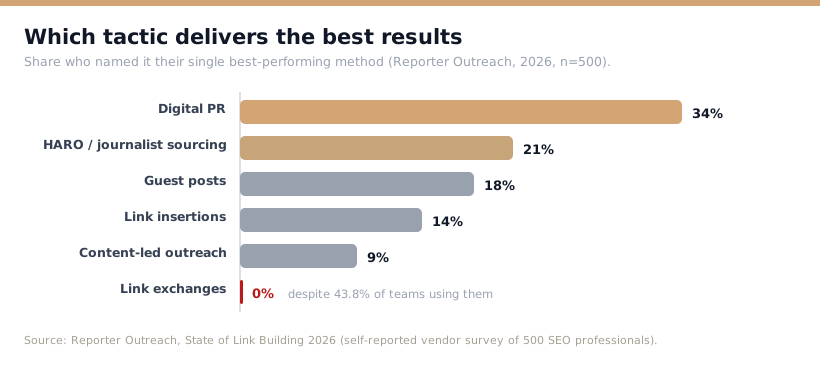
- In a separate survey, 34% ranked digital PR their single best-performing method, nearly double guest posting's 18%, with HARO and journalist sourcing at 21%. (Reporter Outreach, 2026.)
- uSERP's respondents put digital PR first too (20%), ahead of content marketing (18%) and guest posting (12%). (uSERP, 2025.)
- FatJoe found 73% planned to use digital PR in 2025, edging out blogger outreach and guest posts at 68%. (FatJoe, late 2024.)
The most revealing number is the gap between what people use and what works. In Reporter Outreach's survey, adoption is nearly identical across tactics (digital PR 45.6%, broken link building 44.0%, link exchanges 43.8%, guest posts 42.4%), but the results are not:
- 43.8% of practitioners use link exchanges, and exactly 0% named them their best-performing tactic. (Reporter Outreach, 2026.) The widest "everybody does it, nobody wins at it" gap in the data.
- Combined, PR-style approaches (digital PR plus journalist sourcing) deliver the best results for 55% of respondents. (Reporter Outreach, 2026.)
Digitaloft studied 500 digital PR campaigns and 45,753 earned links to see what one produces: the average campaign earns links from 42 unique referring domains, at an average Domain Rating of 41 (82% followed, 18% nofollow). (Digitaloft, February 2026.)
On the production side, 95.9% of digital PR practitioners say pitching data-led content is their most common tactic, and a single full-time digital PR generates a weighted average of 15.58 links per month. (BuzzStream State of Digital PR 2026; BuzzStream 2025.)
Link quality standards
The "quality over quantity" debate is effectively over. The market voted with its money.
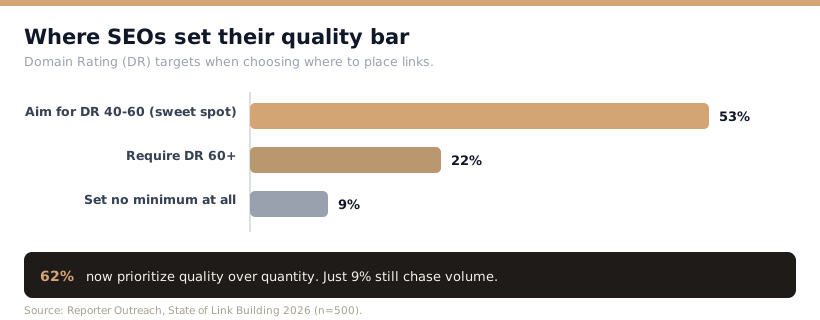
- 62% of SEOs prioritize quality; only 9% still chase volume; 29% pursue both. (Reporter Outreach, 2026.)
- 53% target Domain Rating 40 to 60 as their sweet spot. Only 9% chase DR 70+, and 9% set no minimum at all. (Reporter Outreach, 2026.)
- 64.1% use Ahrefs DR or UR as their go-to authority metric. Among digital PR specialists, Ahrefs DR adoption hits 93.2%. (Editorial.link, 2026; BuzzStream, 2026.)
- For link quality overall, 87.2% weigh site relevance and 85.8% weigh DA/DR, the top two criteria. (BuzzStream, 2026.)
Two findings cut against legacy advice:
- 78.8% of specialists believe nofollow links impact rankings, despite Google treating nofollow as a "hint." uSERP's survey agreed, with 54% saying nofollow links improve authority. (Editorial.link, 2026; uSERP, 2025.)
- 80.9% see value in unlinked brand mentions as a ranking signal. (Editorial.link, 2026.)
And one quiet admission that explains a lot: 91.9% of specialists are convinced their competitors buy backlinks. (Editorial.link, 2026.)
Link building in the age of AI search
This is the section that will look most different a year from now. The data is early, but the direction is unmistakable, and it changes what link building is for.
First, the scale of the shift:
- Google's AI Overviews now reach over 2 billion monthly users across 200+ countries, and AI Mode has passed 100 million monthly active users in the US and India. (Google, as of its July 2025 earnings.)
- AI Overviews appeared on roughly 48% of searches by early 2026, up from about 30% a year earlier. (BrightEdge, February 2026.)
Then, the cost to traditional clicks:
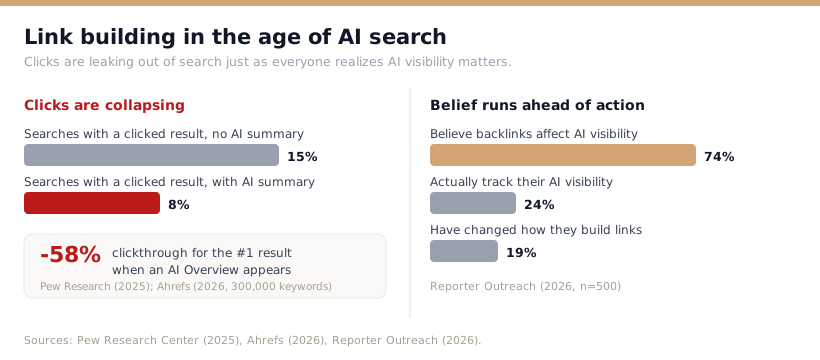
- Pew Research found that users click a search result link in just 8% of visits when an AI summary is shown, versus 15% without one, roughly half as often. They click a link inside the AI summary in only 1% of visits. (Pew Research Center, 900 US adults, 68,879 searches, July 2025.)
- Ahrefs found the presence of an AI Overview correlates with a 58% lower clickthrough rate for the top-ranking page. (Ahrefs, 300,000 keywords, February 2026.)
If clicks are collapsing, getting cited inside the AI answer becomes the goal, and the data says links and mentions still feed it:
- Branded web mentions are the factor most correlated with appearing in AI Overviews (0.664), correlating about 3x more strongly than backlinks (0.218). Referring domains land in between (0.295). (Ahrefs, ~75,000 brands, May 2025.)
- 76.1% of pages cited in AI Overviews rank in Google's top 10, and 86% rank somewhere in the top 100. Ranking still feeds citation. (Ahrefs, 1.9 million citations, July 2025.)
- 73.2% of specialists believe backlinks influence whether a brand appears in AI search results. (Editorial.link, 2026.)
But belief is running far ahead of action, and that gap is the opening right now:
- 74% believe backlinks impact AI search visibility, yet only 19% have changed how they build links, and just 24% are even tracking their AI visibility. (Reporter Outreach, 2026.)
- 75% of digital PRs have already been approached about using digital PR to win AI citations, and AI has "fundamentally changed" how 76.4% of them work. (BuzzStream, 2026.)
- Still, only 11% of teams claim a repeatable, reliable process for getting cited in AI results. (BuzzStream, 2025.)
The catch: your links don't last
One statistic rarely makes it into these roundups, and it should: the links you work to build are quietly dying.
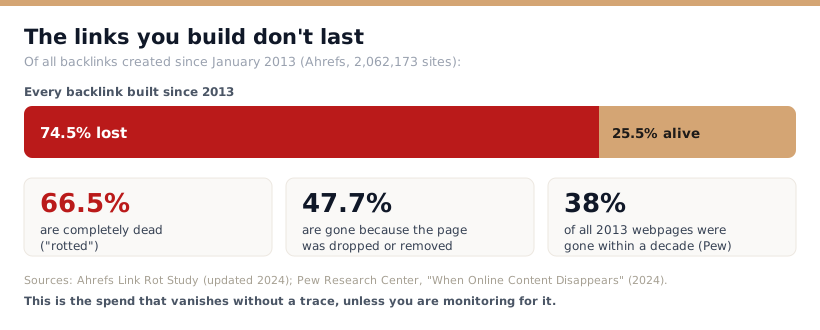
Ahrefs tracked links to 2,062,173 websites going back to January 2013. The finding:
- 66.5% of those backlinks are now completely dead ("rotted"). Counting temporary errors and other failures, 74.5% are considered lost. The single largest cause is pages being dropped or removed entirely (47.7% of links), not the occasional 404. (Ahrefs link rot study, updated February 2024.)
The broader web backs this up. Pew Research found that 38% of webpages that existed in 2013 were gone within a decade, that 54% of Wikipedia pages now have at least one dead link in their references, and that 23% of news pages carry a broken link. (Pew Research Center, May 2024.) Link rot is not an edge case. It is the default state of the web over time.
That curve is just as steep for the links you build yourself. Linkody, a backlink monitoring tool, ran a survival analysis on the links it tracks: roughly 8% of acquired backlinks disappear within three months, about 18% within the first year, and only 56.6% survive to seven years. (Linkody link rot study, 2022.)
This is the part of link building that the cost data makes painful. If the average quality guest post runs $3,130 and the top-tier ones run north of $6,000, then every link that silently 404s, flips to nofollow after an editorial refresh, or has its anchor swapped is budget evaporating without a trace. You usually find out months later, when rankings slip.
This is exactly the problem I have been building LinkWatchr to solve. The stats above are the reason the category exists: you cannot protect spend you cannot see.
66.5% of backlinks die over time. Which of yours already have?
Link building by industry
Difficulty and cost vary sharply by vertical. The first-party data here is thinner than the rest, so treat these as directional, but every figure below is from an original survey.
Hardest and easiest industries to build links in:
- Finance is the hardest, named by 23.6% of digital PRs, followed by Health and Wellness (20.3%) and Education (19.6%). Finance jumped from sixth-hardest a year earlier to first, which practitioners pin on tighter regulation and stricter editorial scrutiny. (BuzzStream, 2026.)
- Travel is the easiest, named by 46.6%, a spot it has held two years running. (BuzzStream, 2026.)
Which verticals demand the biggest budgets:
- 61% of specialists say gambling (iGaming) requires the highest link building budgets, far ahead of the next sectors: Finance (18.4%), Law (16.4%), Health and Wellness (7.1%), and SaaS (5.8%). (Editorial.link, 2026.)
- In legal, 62% of teams spend more than £601 per month per client, making it the single most expensive vertical in FatJoe's survey. (FatJoe, late 2024.)
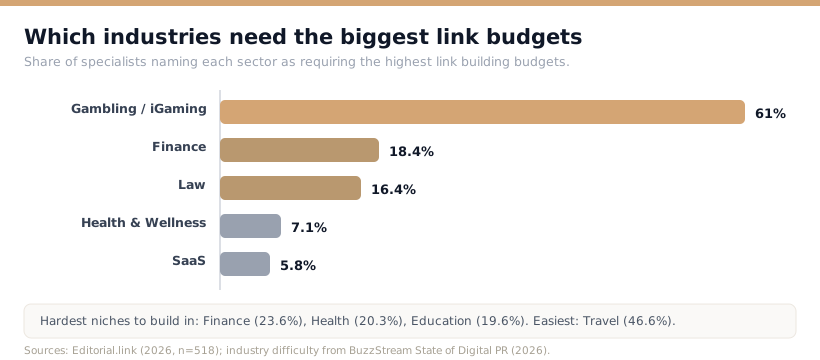
The pattern is consistent: the more a link can move money (finance, gambling, legal, health), the harder and more expensive it is to earn, because everyone in those niches is competing for the same authoritative placements.
How teams manage and measure link building
The operational data explains why so many programs underperform. Most are run on instinct and judged on too short a clock.
- 61% of organizations manage link building entirely in-house, with about a third using a mix of in-house and agencies or freelancers. (BuzzStream, 2025.)
- Only 32% follow a documented, repeatable process. 68% describe their approach as spontaneous or unplanned. (BuzzStream, 2025.)
- 60% of teams get just three to six months to show value. (BuzzStream, 2025.)
- Only 29% say their link building is successful, and just 30% of teams working with external link builders are fully confident in the results. (BuzzStream, 2025.)
Measurement is the soft spot everyone admits to:
- 63% want to get better at reporting on impact and ROI, and only 40% feel their current reports show the value of the investment. (BuzzStream, 2025.)
- 52.9% of specialists say measuring ROI and effectiveness is hard, and 55.2% call link building the single most challenging part of SEO. (Editorial.link, 2026.)
- Reflecting that difficulty, 39.2% of digital PRs do not even know their own cost per link (down from 51.4% the year before, so it is improving). (BuzzStream, 2026.)
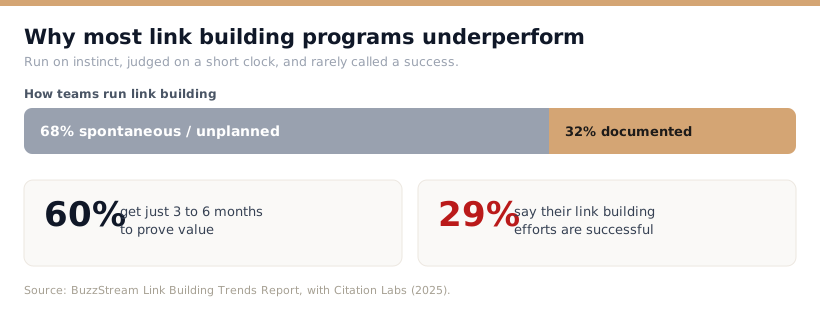
The throughline: link building is widely run without a documented process, judged on a short timeline, and hard to measure, which is a tough combination to defend in a budget meeting.
5 link building stats you should stop citing
Part of doing this honestly is naming the numbers that failed the check. These five are everywhere. None of them survived first-party verification.
- "94% of marketers say quality matters more than quantity." Usually attributed to Authority Hacker. The figure does not appear anywhere on Authority Hacker's survey page. The page exists, the survey is real, but that specific stat is not in it.
- "55% of pages have zero referring domains." Commonly credited to Backlinko. It is not in any Backlinko study. The real, comparable Backlinko finding is that 94% of content gets zero external links (2019).
- "Long-form content gets 3.5x more backlinks." Backlinko's actual finding is that content over 3,000 words earns about 77% more referring domains than short content, not 3.5x. (And it is from 2019.)
- "Blogging gets you 97% more links." Traced back, this one cites a third party, has no disclosed methodology, and dates to roughly 2015. Not original research, and far too old to present as current.
- "95% of pages have zero backlinks" (Ahrefs). Ahrefs measured zero traffic, not zero backlinks. The real figure is that 96.55% of pages get zero traffic from Google (14 billion pages, 2023). Different metric entirely.
The lesson is not that these tools publish bad data. Ahrefs and Backlinko run some of the best studies in the industry. The lesson is that roundups mangle good data, and the mangled version travels faster than the original.
What this means for your 2026 strategy
Pulling the verified numbers together, five things stand out:
- Links still matter, but they are table stakes, not a silver bullet. Correlations are real but weak (0.255), and 64.9% of SEOs think you can rank without backlinks. Build links to compete, not to win on their own.
- Budget up or get sharper. 64% spend $3,000+ a month and 80.9% expect costs to rise. If you are under that, your edge has to be selectivity, not volume.
- Reweight toward digital PR. It is the consensus top performer across four separate surveys, while link exchanges convert to "best result" for literally no one.
- Start tracking AI visibility now. 74% believe it matters, only 19% have acted. That gap is the cheapest first-mover advantage on the board this year.
- Protect what you have already paid for. Two-thirds of links die over time. Monitoring earned links is the highest-ROI, least-done habit in the discipline.
Sources and methodology
Every statistic in this article was verified against the original publisher's own page in June 2026. Studies are listed with their sample size and publication date so you can check any figure yourself.
- Ahrefs, Link Rot Study (2,062,173 sites, updated Feb 2024)
- Ahrefs, AI Overviews and Brand Correlation (~75,000 brands, May 2025)
- Ahrefs, Links Matter Less but Still Matter (1,000,000 SERPs, Jan 2025)
- Ahrefs, Search Rankings and AI Citations (1.9M citations, Jul 2025)
- Ahrefs, AI Overviews Reduce Clicks (300,000 keywords, Feb 2026)
- Editorial.link, Link Building Statistics for 2026 (518 SEO professionals, Mar 2026)
- uSERP, State of Backlinks for SEO 2025 (800+ SEOs, 2025)
- Reporter Outreach, State of Link Building 2026 (500 SEO pros, Q1 2026, self-reported vendor survey)
- BuzzStream, State of Digital PR 2026 (150+ digital PR pros, Feb 2026)
- BuzzStream, State of Digital PR 2025 (150+ digital PR pros, survey late 2024)
- BuzzStream, Link Building Trends Report (with Citation Labs, Apr 2025)
- BuzzStream, Guest Post Costs (257,267 sites, Jun 2026)
- BuzzStream, Link Insertion Costs (421,259 sites, Jun 2026)
- FatJoe, The Future of Link Building 2025 (536 respondents, late 2024)
- Digitaloft, Digital PR Success Study (500 campaigns, Feb 2026)
- Backlinko, Search Engine Ranking Factors (11.8M results, orig. 2016)
- Backlinko, Content Study with BuzzSumo (912M posts, 2019)
- Semrush, How Long Does It Take to Rank (2,155 domains, Mar 2023)
- Google, Alphabet Q2 2025 CEO remarks (Jul 2025)
- BrightEdge, AI Overviews One-Year Tracking (Feb 2026)
- Pew Research Center, Google Users and AI Summaries (900 US adults, Jul 2025)
- Pew Research Center, When Online Content Disappears (May 2024)
- Linkody, Link Rot Study (survival analysis of monitored backlinks, 2022)
Link Building Statistics FAQs
Are backlinks still a Google ranking factor in 2026?
Yes, but the correlation is weaker than it once was. Ahrefs' 2025 analysis of a million SERPs put the referring-domains-to-rankings correlation at 0.255, positive but modest. Links help you compete; they are no longer a guarantee, and 64.9% of SEOs now believe a site can rank without them.
What is the most effective link building tactic right now?
Digital PR, by consensus. It was rated the most effective tactic by 48.6% of SEOs in Editorial.link's 2026 survey, and the single best-performing method by 34% in Reporter Outreach's survey, nearly double guest posting.
How much does a backlink cost in 2026?
By method and first-party data: link insertions average $179, guest posts $295 direct or $461 via a vendor, and high-quality placements $3,130 to $6,018. SEOs say they will pay $508.95 on average for a single quality link, and 76% now pay at least $300.
Do nofollow links still count?
Google treats nofollow as a hint rather than a direct ranking signal, but practitioners disagree on its real-world effect: 78.8% of specialists believe nofollow links impact rankings, and they reliably drive referral traffic and brand visibility.
How many backlinks are lost over time?
A lot. Ahrefs found 66.5% of links created since 2013 are now dead, and 74.5% are lost when you include errors and removed pages. Pew Research separately found 38% of 2013-era webpages were gone within a decade. This is why monitoring earned links matters.
Does link building help with AI search visibility?
Indirectly, and the data is still forming. Branded mentions correlate most strongly with AI Overview visibility (0.664), ahead of backlinks (0.218), and 76.1% of AI-cited pages rank in Google's top 10. Most SEOs (74%) believe backlinks matter for AI visibility, but only 19% have changed their approach.
Start monitoring today
Never lose a backlink again
Track every backlink automatically and get instant alerts the moment something changes.