How Many Backlinks Per Day Is Safe? Nobody Tested It. I Checked.
Written ByReviewed byUpdated


On this page
- First, why is this even a question?
- What 36 articles claim, and why you can't believe any of them
- Where these numbers actually come from
- What Google actually says
- The proof it isn't velocity
- So what actually gets sites hurt
- The honest caveats (so nobody misreads this)
- The question worth asking instead
- The part every article on this skips
- So, how many backlinks per day is safe?
- How I researched this
- Sources
Ask the internet how many backlinks per day is safe and you get a number, fast. Five to ten a day. One to three for a new site. No more than fifteen. Twenty to thirty once you are established. The numbers are stated with total confidence, in tidy tables, under headings like "2026 Updated Guidelines."
Here is the problem. Not one of them is real.
I collected every article I could find ranking for this question, 36 of them with an actual answer to pull. Then I lined the answers up next to each other and checked each one against what Google has actually said and what the evidence actually shows. What I found is not a small disagreement at the edges. It is a field that invented a number, copied it from each other for a decade, and never once tested it. Below is the whole thing: what they claim, where the numbers came from (nowhere), what Google is on record saying, and what actually gets a site hurt. It is not the speed.
First, why is this even a question?
Step back before the tables and analogies. Strip the jargon and the question is: "Can a website get too much genuine approval from the rest of the web, too quickly?"
Say that out loud and it falls apart. A backlink is another site vouching for you. If every publication on earth linked to your product tomorrow because it is that good, that is not a risk you need to manage down. That is the single best day your site will ever have. Nobody at Google is sitting there thinking, "This page is getting too popular too fast, let's bury it."
So the fear cannot be about real links. It has never been about real links. When people ask how many backlinks per day is safe, the thing they are actually afraid of is getting caught buying or manufacturing fake ones. That is a completely reasonable fear. But it turns the question into something different: not "how fast can approval arrive," but "how much manufactured approval can I fake before Google notices." And the honest answer to that is not a daily number either, which is exactly what the next few sections show.
Hold that distinction, because it is the whole article: real links have no dangerous speed limit, and fake links are not made safe by going slow. A slow drip of PBN links is still a PBN. "How many per day" is the wrong axis entirely.
What 36 articles claim, and why you can't believe any of them
I read all 36 and recorded the exact number each one gives for a "safe" daily pace. Here is what the supposed consensus looks like when you actually stack it up.
For the identical scenario, a brand-new site under six months old, the advice ranges from less than one link a day to thirty a day, depending on which blog you happened to land on:
- Around 0.2 to 0.3 a day (five to ten links a month): Digital World Institute, Saalinko.
- One to three a day: Backlink Guys, Jeenam Infotech.
- Two to five a day: backlink-tool.org, and Jeenam's own intro (which then says one to three lower down).
- Five to ten a day: CustomMapPoster, Desire Marketing, Doyen Marketers, Lamphills, BacklinkManager.
- Ten a day: Marketing1on1.
- Ten to twelve a day: Rankknar.
- Twenty-five to thirty a day, for a new site: Seonza.
Same input. Answers that disagree by 30x, and by more than 200x if you count the "five a month" crowd against the "thirty a day" crowd. These are not nuanced differences of opinion about a hard problem. They are numbers pulled out of the air by people who never checked, and it shows the moment you put them side by side.
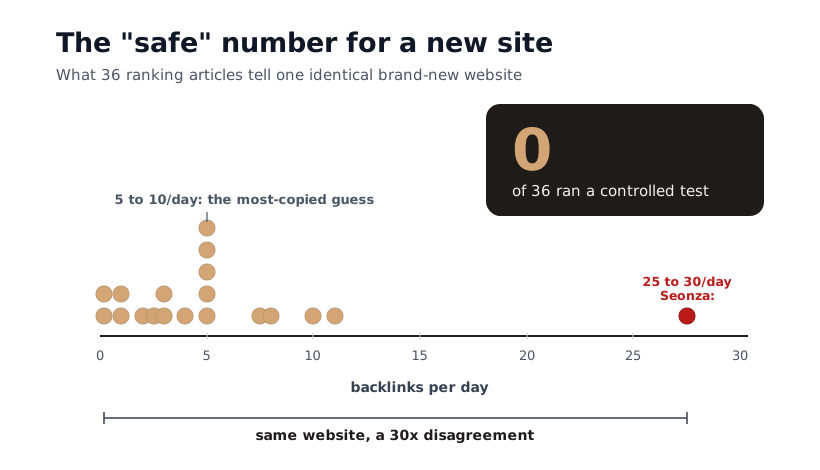
Then there is the other half of the field, the sites that quietly admit there is no number at all: SEOptimer ("No, there's no limit!"), MarketingLad ("1 link or even 500 links every day without risk"), and SirLinksalot ("hundreds or thousands of editorial backlinks per day" is fine when it is natural). So within the same search results, you can read that fifteen links a day will get you penalized and that five hundred a day is perfectly safe. Both are presented as expert guidance.
The number that matters most: how many of the 36 ran or cited an actual controlled experiment? Zero. Not one built two comparable sites, fed them links at different speeds, held everything else equal, and measured what happened. The entire body of advice on "how many backlinks per day is safe" rests on nobody having tested it.
Where these numbers actually come from
If none of them tested anything, where did "5 to 10 per day" come from? I can show you, because the seams are visible.
Somebody made it up, and everyone copied it. The most-repeated framework in the whole set is a tidy age-based tier: one to three a day for a new site, five to ten when it is growing, twenty to thirty-plus once established. It appears almost word for word across Jeenam Infotech, Backlink Guys, and WebSavvy Solution, and in softened forms on half a dozen more. No two of them cite a source for it, because there is no source. It is a shape that reads like real guidance, so it gets reproduced. The flat "5 to 10 a day" figure shows up verbatim on at least five sites, none of which say where they got it.
Some of them do not believe their own number. Read closely and the articles argue with themselves inside a single page:
- Rankknar gives you "25-30 backlinks can be considered safe," then admits two paragraphs later: "The above mentioned method is not recommended by search engines or documented anywhere, it's just what I have learned over the years." That is the most honest sentence in the entire corpus. The number is a personal hunch wearing a lab coat.
- Marketing1on1 opens with "there is no 'safe' number of backlinks per day," then tells you to "create around ten backlinks daily for a new website," then says an established site can "safely create 100 quality backlinks daily." Three different answers, one page.
- MarketingLad's intro states "there is a daily limit to the number of backlinks you can build." Its body states "you can build 1 link or even 500 links every day without risk... there is no limit."
Some of the authors are not real. CustomMapPoster, a store that sells custom map posters, ranks for this SEO question with an article bylined "Clemencia Bogisich Ret," whose auto-generated bio lists a fake Kentucky address, the job title "Central Hospitality Director," and hobbies including "Lockpicking." RankingChamps credits a "James Robert." BacklinkManager runs its advice under "Mian Bilal, Digital Dynamo." Backlink Guys backs its numbers with a block of quotes attributed to John Mueller, Brian Dean, and Neil Patel, none of them sourced, dated, or findable. When the author is invented, the expertise behind the number is too.
Some of them are selling the exact thing they warn you about. MonsterPBN, a private blog network vendor, publishes a month-by-month "safe growth" spreadsheet (start at one link every three days, reach twenty-six a day by month twelve) and cautions that adding links in a steady pattern can get you caught for "footprinting." A company that sells footprints, advising you on how to hide them, using numbers it invented for a spreadsheet. This is the state of the art on this keyword.
And now Google is laundering it back to you. Search the question today and Google's AI Overview sits above all 36 of these blogs and answers in their exact voice, because it was trained on them. It reports that "1 to 3 high-quality links is the safest, standard daily rate," that a new site should aim for one to three a day (about ten to thirty a month), and that an established site can scale to ten to thirty a day. Then it shows its sources, and they are these same blogs: the version I captured cites Mavlers and Medium among them, two of the exact articles in this analysis, neither of which ran a test. Google's own answer engine took the cargo-cult number, put it in an authoritative box, and cited the cargo cult as its proof.
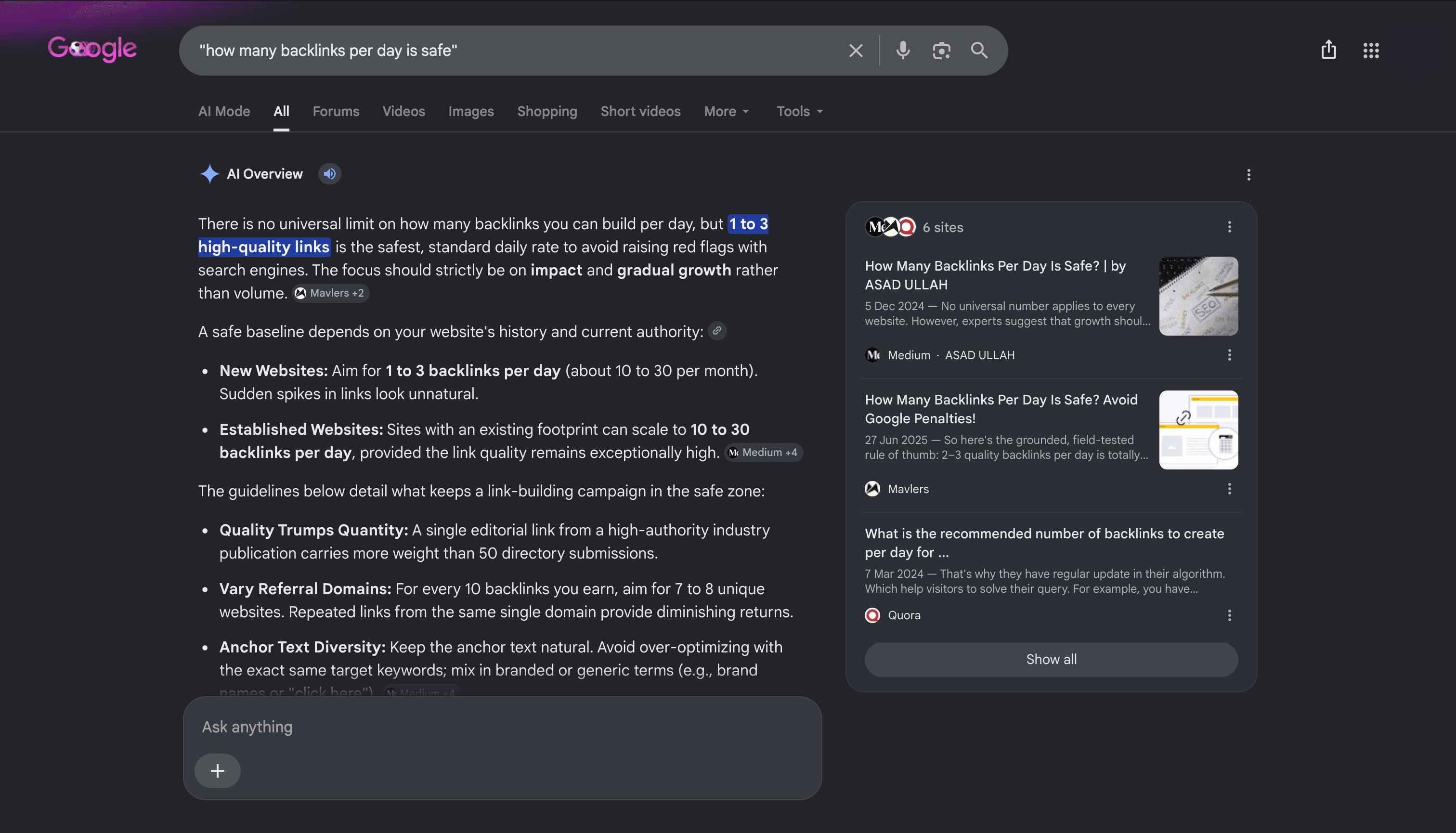
That is the misinformation flywheel in one picture. A writer needs a post on this keyword. They do not test anything, because testing is slow and expensive and nobody is checking. They glance at the sites already ranking, average the numbers, add a gym analogy, and publish. The next writer does the same to them. Ten years of this, and the average has calcified into "5 to 10 a day," a figure with no origin and no evidence, now being read aloud by an AI as if it were law.
Someone has to actually check. So here is the check.
What Google actually says
There is a shortcut past all 36 opinions: go to the source. Google has addressed this directly, more than once, on the record. The picture it paints is the opposite of the blog consensus.
Google does not count links per day. John Mueller of Google, asked in 2021 whether you could build so many links to a page that it stops ranking, answered plainly: "We don't count links like that." Two years earlier, addressing link velocity head on, he said the concern is whether links are unnatural, "it doesn't really matter how many or in which time." (Via Search Engine Journal and Search Engine Roundtable.) There is no daily counter. There is no velocity threshold that trips a wire. Gary Illyes of Google has separately called "link velocity" a made-up term the search team does not use.
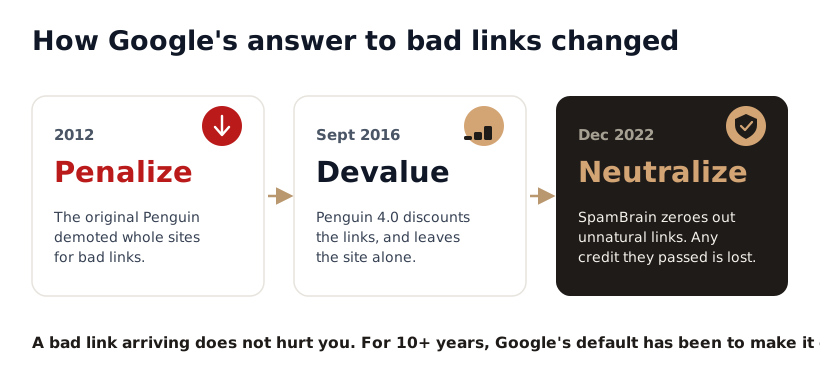
When Google sees links it distrusts, it ignores them. It does not punish you for them. This is the piece the "you'll get penalized" articles miss entirely, and it is the most important shift in how link spam has worked for the last decade:
- 2012: the original Penguin algorithm demoted whole sites for bad links. This is the era the scary advice is stuck in.
- September 2016: Penguin 4.0 changed the model. In Google's own words, Penguin now "devalues spam by adjusting ranking based on spam signals, rather than affecting ranking of the whole site." It stopped punishing the site and started discounting the links.
- December 2022: the link spam update put Google's AI system SpamBrain on the job, to "neutralize" unnatural links so that any credit they passed is simply "lost."
Read those together. For over ten years, Google's default response to a link it does not trust has been to make it count for nothing. No notification, no manual penalty, just zero value. Mueller has said it in plain language: for spammy links, "we will try to ignore it." You do not get punished for a bad link arriving. It just does not help you. That is a wasted-money problem, not a penalty problem, and it is a distinction the whole SERP gets wrong.
The one thing Google does actively penalize, through a manual action a human reviews, is your own participation in a link scheme: buying links, running a PBN, mass-producing exact-match anchor guest posts. Google's current spam policy defines link spam as links created "primarily for the purpose of manipulating search rankings." Notice what is not in that definition: a number, a rate, a per-day cap. It is a test of intent and method, not of speed.
The proof it isn't velocity
Google's statements are one thing. What actually happens in the wild is another, and the wild agrees with Google. If raw speed triggered penalties, the web would be littered with the wreckage. It is not.
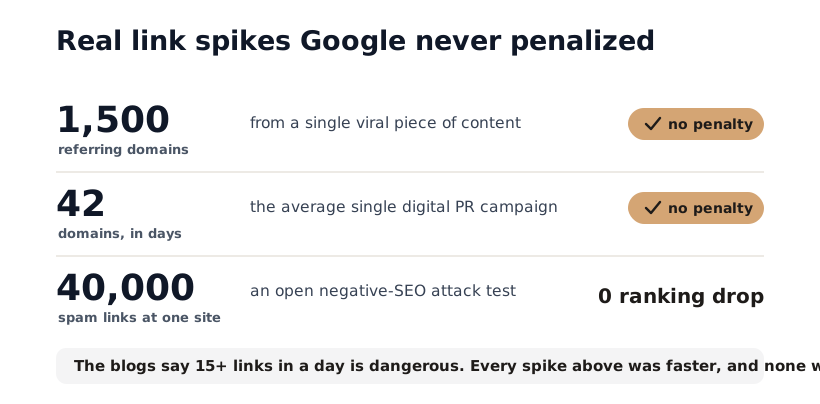
Real sites gain links faster than any "safe" guideline, and rank better for it. When a piece of content or a product goes genuinely viral, the link acquisition is not gentle. Ahrefs documented its own link bait pieces pulling thousands of backlinks from well over a thousand referring domains, fast, with no ill effect. When ChatGPT launched, it added referring domains at a rate no blogger would ever call "safe," and it sits at the top of the web. None of these got a velocity penalty, because there is no such thing.
The industry's most-recommended tactic is a deliberate link spike. Digital PR exists to make a story land everywhere at once. Digitaloft studied 500 digital PR campaigns and found the average campaign earns links from 42 referring domains, often within days of a story breaking. That is a velocity that dwarfs "5 a day," it is what agencies charge thousands to produce on purpose, and Google treats it as a trust signal. If speed itself were dangerous, the entire digital PR industry would be a penalty machine. It is the opposite.
People have tried to weaponize velocity against competitors. It doesn't work. If pointing rapid spam links at a site could tank it, negative SEO would be a solved problem and every ranking would be under attack. Rand Fishkin famously invited people to try it on his own domain and collected roughly 40,000 questionable links. His rankings did not move. Google sent a note saying it was ignoring the links, which is the whole point: Google's public position, stated by Mueller, is that it is "really good at dealing with random spammy links" pointed at you by someone else. That is only possible if the count and speed of incoming links is not a penalty trigger. (Via Search Engine Journal.)
Even the one honest experiment in the whole corpus points here. SEO.ai is one of the few that tried to actually compare cases instead of asserting a number. It describes two six-month-old sites that each gained about 1,500 links in 30 days, roughly 50 a day, the same pace. One got penalized. One did not. Same velocity, opposite outcome. The variable that differed was not the speed. It was the quality, relevance, and anchor pattern of the links. Its conclusion: "there is no definitive limit on how many backlinks you can build in a day before Google penalizes your site." The cases are unnamed, so treat it as illustrative, not proof. But it is the closest thing to a test on this entire keyword, and it lands exactly where Google's statements do.
So what actually gets sites hurt
Sites do get penalized for links. That part is real. The blogs are not hallucinating the danger, they are misnaming it. The cause is never the raw count. It is the fingerprint of manipulation, the set of signals that say "a human built these to game rankings, not to earn them."
Walk through the famous cases and it is the same story every time. JC Penney, Overstock, Interflora, Rap Genius: every one was hit for a scheme, not a speed (documented in MarTech's roundup of brand penalties). Paid links with exact-match commercial anchors. Advertorials placed across dozens of sites with near-identical anchor text. Links traded for favors at scale. The timing sometimes helped Google notice, but the thing it acted on was the manipulation, not the calendar.
The blogs' own penalty stories prove the point when you read them carefully. Digital World Institute tells a great one: a client lost 70% of its organic traffic after building "5 PBN links per day for 30 days." Five a day. Well inside every "safe" guideline in this article. But the writer is honest about the real cause, and it was not the five: every one of those PBN domains sat on the same IP block, showed fake traffic signals, was a recycled expired domain, and pointed at commercial money pages. That is a manipulation fingerprint with five fingers. The velocity was a rounding error. A site earning five genuine editorial links a day would never have been touched.
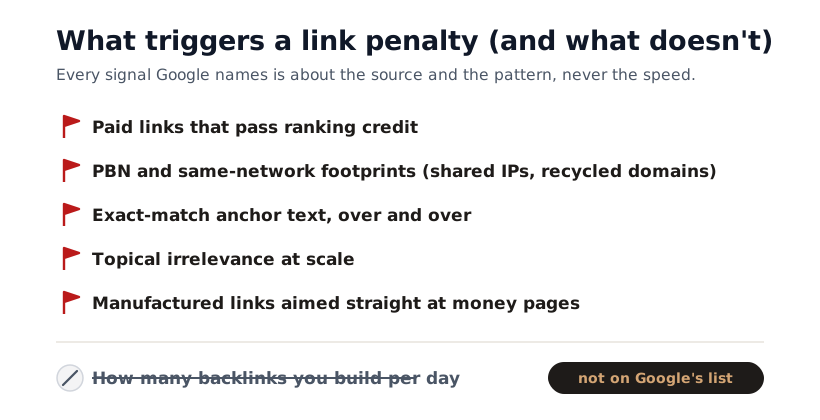
Here is the actual list of what moves Google against a link profile:
- Paid links that pass ranking credit. Money for dofollow links, no
rel="sponsored". - PBNs and same-network footprints. Shared IPs, shared templates, recycled expired domains, fake traffic.
- Over-optimized anchor text. The same exact-match commercial keyword as your anchor, over and over. Natural profiles are mostly branded and URL anchors.
- Irrelevance at scale. Hundreds of links from sites with no topical connection to yours.
- Money-page targeting. Manufactured links pointed straight at your commercial pages instead of your content.
Notice that "how many per day" is on none of these lists, and neither is any number at all. You could build every one of these signals slowly, one careful link a day, and still get flagged, because slow does not launder a fake link. And you could earn a thousand real links in a week and be fine. The axis was never speed.
The honest caveats (so nobody misreads this)
"There is no velocity penalty" is not a green light to blast spam. It is a correction of the mechanism, and the correct mechanism still has real limits. Three things are true at once:
- Fake links do not become safe by being slow, but they are still a waste of money. Since Penguin 4.0, most spam links get quietly devalued rather than punished. So the usual outcome of buying junk is not a dramatic penalty, it is a slow leak: you pay for links that Google zeroes out, and you never see the value. Bad economics, not necessarily a disaster.
- On a weak or brand-new site, a spam-heavy profile can still hurt, because of proportion, not speed. If 90% of a tiny site's links are obvious junk, Google may struggle to isolate and ignore them and can lose trust in the site overall. Mueller has described exactly this. The trigger is the share of your profile that is manipulative, not the rate it arrived.
- Running your own scheme still earns a manual action. Buy links at scale, run a PBN, mass-produce exact-match guest posts, and a human reviewer can still hit you. That has not changed. It is about what you did, not how many landed on a Tuesday.
The question worth asking instead
If "how many backlinks per day is safe" is the wrong question, here is the right one: are the links I am getting real, relevant, and are they sticking?
That reframes it into things you actually control: whether the links are earned or manufactured, whether the anchors are natural (mostly branded and URL, with exact-match kept rare), and whether the linking sites are relevant. Answer those and the daily count answers itself. There is a fourth check nobody runs, whether the links you already have are still live, and it is where the real money leaks out, which is the whole next section.
Velocity has exactly one legitimate use, and it is as a self-diagnostic, not a Google rule. If your link count is spiking, ask why. If the answer is "a great piece got picked up" or "our PR landed," wonderful, keep going, there is no ceiling. If the answer is "I bought a package of 200," the spike is not the problem, the package is. Fast is only a warning sign because fast is usually how bulk-bought junk arrives. Fix the source and the speed stops mattering.
The part every article on this skips
Here is what a decade of "how many per day is safe" articles never gets to, because they are all fixated on a penalty that does not exist. The real risk of chasing links is not that Google punishes you. It is that you spend real money on links that quietly stop counting, and you never find out.
Two things silently drain the value out of a link profile, and neither is velocity:
- Devaluation. Buy links that trip Google's spam signals and they get zeroed out, per everything above. You paid, Google shrugged, nothing happened for your rankings.
- Rot. Even your good, earned links die on their own. The data is stark: about two-thirds of all backlinks eventually go dead, and roughly a fifth of the links you build are gone within the first year, quietly removed in an editorial refresh, flipped to nofollow, or 404'd when a page moves. No alert. You find out months later when rankings slip.
Both problems are invisible unless you are watching. And "watching every link's status on a schedule" is not something a spreadsheet does for you past your first few dozen links. This is the gap I have spent the last couple of years building LinkWatchr to close: it keeps a record of every link you earn or buy (with the cost, the source, and the contact), checks each one on the schedule you set, and emails you the moment one is removed, turned nofollow, has its anchor changed, or drops out of Google's index. It starts around $10 a month, less than the cost of a single lost link. Here is how it works:
If you want the full method behind this, we wrote a dedicated guide on backlink management, including why the "disavow your toxic links" advice is a waste of time for almost every site (Google says so itself).
Stop paying for links you can't see
So, how many backlinks per day is safe?
The real answer, the one nobody wants to print because it does not fill a tidy table: as many real, relevant links as you can legitimately earn, and zero manufactured ones. There is no daily number, because Google does not count links by the day. There never was one. The figures you have read, the five to ten, the one to three, the "never more than fifteen," were invented by people who did not test them, copied by people who did not check them, and are now being recited by an AI that learned them from the copies.
Stop asking how fast you can build. Ask whether the links are real, and whether the ones you already have are still alive. That is the question with an actual answer, and it is the one that protects your rankings and your budget.
How I researched this
For anyone who wants to know how the sausage got made, because the whole point is that most articles on this topic skip this step:
- I gathered the field. Every article I could find ranking for or targeting "how many backlinks per day is safe," 36 with a real answer to extract, plus the duplicates and dead pages that got tossed.
- I recorded the exact claim from each. The specific number, the site stage it applied to, and whether the article cited anything at all to back it. The tally: zero controlled experiments, and more than twenty pure assertions with no source.
- I checked every claim against primary sources. Google's own blog posts and documentation, and on-record statements from John Mueller, Gary Illyes, and Matt Cutts, linked throughout and listed below.
- I cross-checked against the real world. Documented viral link spikes, digital PR benchmarks, negative-SEO experiments, and the well-known brand penalties, to see whether outcomes matched the theory. They matched Google, not the blogs.
Every number and quote above is linked to its source. If a claim in this article is not sourced, it is not in this article.
Sources
The full evidence trail, in one place. Each source is linked once at the point it is used: most are cited inline in the section above, so they appear here as plain text rather than a second link to the same page.
- Google Search Central, Penguin is now part of our core algorithm (Sept 2016)
- Google Search Central, December 2022 link spam update
- Google Search Central, Spam policies (Link spam)
- Search Engine Journal, John Mueller on link velocity (Oct 2019)
- Search Engine Roundtable, Google on the speed of link building (Jan 2021)
- Search Engine Journal, Google on spammy backlinks and negative SEO (Mar 2024)
- Ahrefs, Link Bait (examples of viral link acquisition)
- Digitaloft, Digital PR Success Study (500 campaigns, 45,753 links)
- MarTech, 10 big brands penalized by Google
- Matt Cutts, Google Webmasters video on link building pace
- The 36 ranking articles analyzed, including Editorial.link (the strongest of the honest minority), plus SEO.ai, SirLinksalot, and Digital World Institute, each linked once inline above.
How many backlinks per day is safe FAQs
How many backlinks per day is safe?
There is no safe daily number, because Google does not count links by the day. John Mueller of Google has said directly, "We don't count links like that," and "it doesn't really matter how many or in which time." Safe depends on whether the links are real and relevant, not how many arrive in 24 hours. Earned links from relevant sites carry no dangerous speed limit. Manufactured links are a risk at any speed, including one a day.
Can too many backlinks in one day hurt your site?
Not if they are genuine. Real sites gain hundreds or thousands of links in a day during a viral moment or a PR hit, with no penalty, because Google reads that as popularity. What hurts is a profile that looks manufactured (paid links, PBNs, exact-match anchors, irrelevant sources), and that hurts whether the links arrive in one day or over three months. The day count is not the trigger.
Is link velocity a Google ranking factor?
No. Google's Gary Illyes has called "link velocity" a term the search team does not use, and Mueller has repeatedly said the rate of link acquisition is not what Google evaluates. Google looks at whether links are natural or manipulative. Velocity is only useful to you as a private signal: a sudden spike is worth investigating because it is often how bulk-bought junk arrives, not because Google is timing you.
How many backlinks per day is safe for a new website?
The 36 articles ranking for this question answer anywhere from less than one a day to thirty a day for a new site, which tells you the number is invented. The real guidance for a new site: build slowly not because speed is dangerous, but because at a low authority a large share of junk links can dominate your profile and cost you trust. Focus on a handful of relevant, earned links (directories, genuine outreach, community mentions) rather than a daily quota.
Can competitors hurt my rankings with spam backlinks?
Almost never. Google says it is "really good at dealing with random spammy links" pointed at you by others, and it simply ignores them. Rand Fishkin once collected around 40,000 questionable links in an open test and his rankings did not drop. This is also the clearest proof that velocity is not a penalty trigger: if it were, negative SEO would be easy, and Google's whole design assumes it is not.
Do I need to disavow backlinks to stay safe?
Almost certainly not. Google states that "most sites will not need to use this tool" because it can judge which links to trust on its own. Disavow is only for sites with a manual action for unnatural links, or that bought spammy links at scale and cannot get them removed. For everyone else it is wasted effort. Your time is far better spent monitoring whether the good links you earned are still live.
Start monitoring today
Never lose a backlink again
Track every backlink automatically and get instant alerts the moment something changes.