Types of Backlinks: The Four-Axis Map of Every Link You Can Build
Written ByReviewed byUpdated


On this page
- Why "is this a good backlink type?" has no one answer
- The four axes: what a backlink actually is
- Axis 1: what the HTML says (dofollow, nofollow, sponsored, UGC)
- Axis 2: where the link sits on the page
- Axis 3: who the link is from (the high DR question)
- Axis 4: how the link got there (the 12 types you can actually build)
- 1. Editorial links you earned (the linkable asset play)
- 2. Digital PR
- 3. Journalist request links
- 4. Niche edits / link insertions
- 5. Guest posts
- 6. Unlinked mentions and link reclamation
- 7. Broken link building
- 8. Directories and citations
- 9. Testimonials, badges, and partner pages
- 10. Forum, Reddit, Q&A, and comment links
- 11. Social profiles and bookmarking links
- 12. Paid links, link farms, and PBNs
- Does your industry change the map?
- The build order: which types to go after first
- Links die. Plan for it from day one.
- Start running the map
Backlink types come at you as a pile of labels: dofollow, nofollow, guest post, editorial, niche edit, footer link, high-DR, PBN. They get presented as one menu, as if you were choosing between parallel options.
They are not parallel. "Dofollow" describes what a link's HTML says. "Guest post" describes how you got it. "Footer link" describes where it sits on the page. "High-DR" describes who it came from. Treating those as one list is like categorizing cars as "sedan, diesel, red, and expensive." Every item is real. The list is nonsense, because those are four different questions about the same car.
That is the whole key to backlink types: every link answers four separate questions at once. One axis for what the HTML says. One for where the link sits. One for who it is from. One for how it got there.
This guide walks all four. And for the types you can actually build, it adds what you need to choose between them: what each one costs (real, sourced figures, not vibes), what Google has said about it on the record, how to get it in practice, and a straight verdict on whether it is worth your time and money.
Why "is this a good backlink type?" has no one answer
Ask around whether guest posts are good backlinks and you will hear yes, no, and "only if they're nofollowed," all delivered with certainty. Nofollow links get dismissed as worthless in one breath while real pages have climbed to number-one rankings after picking them up. PBNs are a time bomb or a ranking weapon, depending on whether the person answering happens to sell them.
The disagreement is built into the question. A type label carries one of the four coordinates, and one coordinate is never enough for a verdict. "Guest post" is not good or bad.
A guest post link can be followed or nofollowed, in the body or in the bio, on a relevant site with real traffic or on a content farm, earned with genuine expertise or bought at $77.80 a placement (a real average, sourced below). Same label, four different links, four different outcomes.
So instead of asking which types are good, ask where a link lands on each of the four axes. Every contradictory opinion you have heard about backlink types resolves there, and the rest of this article walks each axis in depth.
The four axes: what a backlink actually is
Every backlink, no exceptions, is fully described by four coordinates:
- What the HTML says. Followed by default, or qualified with
nofollow,sponsored, orugc. This is the only axis with a fixed, official vocabulary, because Google wrote it. - Where it sits on the page. In the body of the content, in an image, in an author bio, in a footer or sidebar, in a widget, in a comment. Placement changes how much a link is worth and how Google reads intent.
- Who it is from. The linking site's authority, topical relevance, and real traffic. This is the axis where DR and DA live, and where most of the industry's confusion about "high DR backlinks" lives too.
- How it got there. Earned, pitched, placed, traded, or bought. Guest posts, digital PR, niche edits, directories, all of it. This is the only axis you directly control, which is why it is the only one worth calling "types you build."
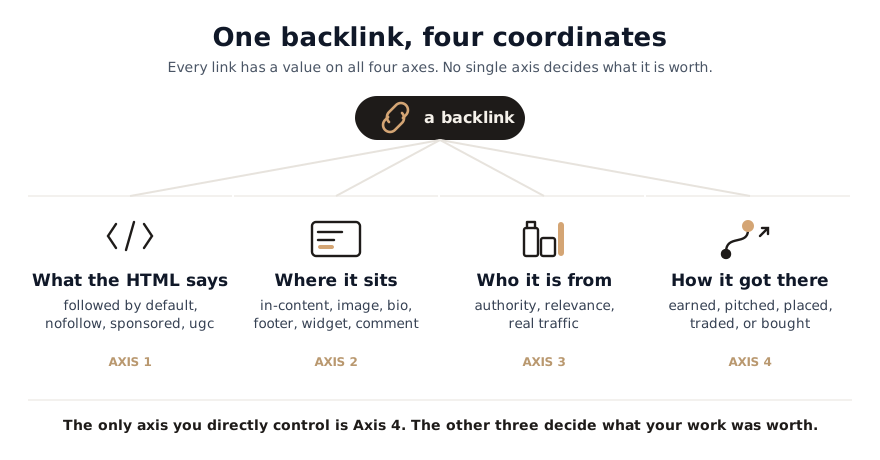
Hold onto one rule as you read: a link's value is set by all four coordinates together, never by one.
A followed link (axis 1) in body content (axis 2) means little from a zero-traffic link farm (axis 3). A nofollowed link from a major publication that sends you actual readers beats it without trying. Every "is X type good?" question is answered by checking the other three axes.
Axis 1: what the HTML says (dofollow, nofollow, sponsored, UGC)
Start with the axis everyone teaches first and half the industry still gets wrong.
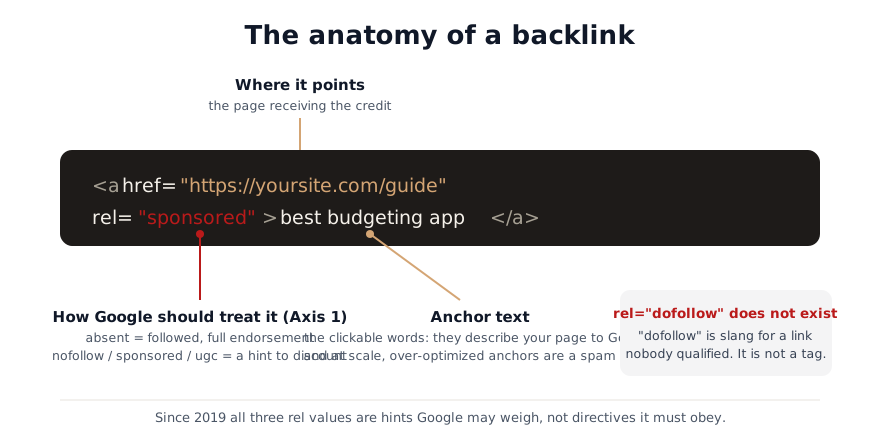
A backlink is an <a> tag on someone else's site pointing at yours. The linking site can qualify that link with a rel attribute that tells search engines how to treat it. There are exactly three qualifying values that matter, plus the default:
| What it looks like | What it tells Google | Introduced |
|---|---|---|
<a href="..."> (no rel value) | A normal, followed link. Full endorsement, passes ranking credit. | The default since links existed |
rel="nofollow" | "I link to this but don't endorse it." | 2005, to fight comment spam |
rel="sponsored" | "This link was paid for or compensated." | September 2019 |
rel="ugc" | "A user posted this, not the site owner." Comments, forum posts. | September 2019 |
One correction before going further: "dofollow" is not a real attribute. There is no rel="dofollow" in HTML, and Google's own documentation lists exactly three qualifying values (nofollow, sponsored, ugc) with no rel attribute needed for regular links. A "dofollow link" is just a link nobody qualified.
The word is industry slang for the default state, which matters because articles that list "dofollow backlinks" as a type you go out and build are describing a property, not a tactic. You cannot build a dofollow link. You can only get a link and hope the site owner does not qualify it.
The second correction is bigger. In September 2019, Google changed how all of these work. Before, nofollow was a directive: Google "would not count any link marked this way." Since then, all three qualifying values are "treated as hints about which links to consider or exclude within Search," and nofollow became a hint for crawling and indexing on March 1, 2020.
Google's own caveat in the same announcement keeps expectations honest: "In most cases, the move to a hint model won't change the nature of how we treat such links." Translation: a nofollow link is usually still ignored for ranking, but the wall between "counts" and "worthless" is now a judgment call Google makes, not a rule you can look up.
So how much should the attribute drive your decisions? Less than the industry's obsession with it suggests, and the data says why.
When Ahrefs studied the top 110,000 sites in 2020, 10.6% of all backlinks to them were nofollow, and adoption of the new attributes was almost nonexistent: rel="ugc" appeared on 0.44% of referring domains and rel="sponsored" on 0.01%. Meanwhile, Digitaloft's analysis of 500 digital PR campaigns found the average campaign's links split 82% followed to 18% nofollowed, without anyone asking for either.
Put those together and you get the practical rules for axis 1:
- Never turn down a link because it is nofollowed. A natural profile contains a meaningful nofollow share, the hint model means some of them may count, and a nofollow link from a page with real readers sends you customers regardless of what it passes.
- Never pay extra for "guaranteed dofollow." A seller advertising the attribute is telling you their links exist to pass ranking credit, which is precisely the thing Google's spam systems are trained to spot.
- Use
sponsoredon links you sell or trade. Google's spam policy states plainly that paid links are "not a violation" when qualified. The violation is an unqualified paid link. Can Google always tell that a quiet, untagged paid link was bought? No. It cannot read invoices, and plenty slip through. What it does instead is profile the sellers: SpamBrain is built to detect "sites used for the purpose of passing outgoing links," and a site that sold to you has sold to hundreds of others, each sale another chance for the pattern to surface. You are not hiding one transaction; you are betting the seller's entire portfolio stays invisible. That math gets a full section further down.
One nearby tag that is not a link attribute but still decides who gets credit: rel="canonical". It lives in a page's head, not on the link, and tells Google "the real version of this page is over there." It matters for backlinks in one common case, syndication: when an article that links to you gets republished across other outlets, the copies usually canonicalize back to the original, so the credit consolidates there instead of multiplying. Digitaloft's campaign data found about 10% of digital PR links end up canonicalized to another page this way. Worth knowing when you count your coverage, not something you control.
Axis 2: where the link sits on the page
The same followed link from the same site is worth different amounts depending on where it physically appears. None of the major tools show you this axis cleanly, but Google has been explicit about it for years, mostly by listing the placements it distrusts.
Think of a page as value zones:
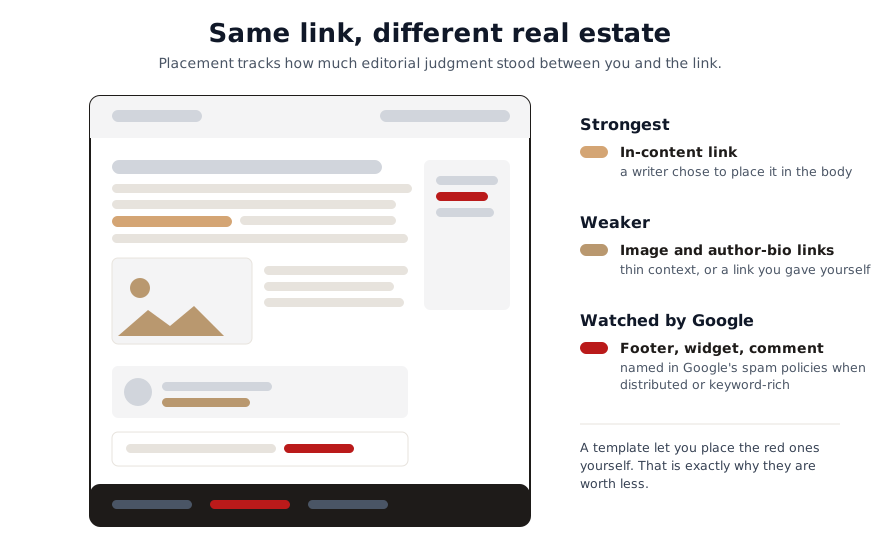
- In-content (contextual) links are the strongest placement: a link inside the flowing body of an article, surrounded by relevant text that tells Google what the link is about and why it is there. When people say "editorial link," they usually mean this placement plus an earned acquisition. The paid market prices the placement too: an in-content insertion averages $361.44 to buy while a guest post (bio link included) averages $77.80, both figures from the Ahrefs experiment covered below.
- Image links (your infographic embedded with a credit, a product photo pointing home) are real but weaker: the anchor text is whatever sits in the alt attribute, and the surrounding-context signal is thinner.
- Author bio links are the placement Google specifically called out in its guest-posting warnings. They are links you gave yourself, in a box readers skip.
- Footer, sidebar, and template links repeat on every page of a site, and Google's current spam policies name "widely distributed links in the footers or templates of various sites" as link spam. A single footer credit on a site you genuinely built is fine, especially with a branded anchor. A footer-link strategy is a 2012 strategy.
- Widget links get their own line in the same policy: "keyword-rich, hidden, or low-quality links embedded in widgets" distributed across sites. If you ship a free widget or badge, make the embedded link nofollow and branded.
- Comment and signature links are named too, with Google's own parody example: "Thanks, that's great info! - Paul, paul's pizza san diego pizza best pizza san diego." That is the placement axis at its bottom.
The pattern across all six: Google's suspicion tracks how much editorial judgment stood between you and the link. An in-content link exists because a writer chose to put it there. A footer, widget, or comment link exists because a template or a form let you put it there yourself. The less a human editor was involved, the less the placement is worth, and past a point, the more it looks like spam.
Axis 3: who the link is from (the high DR question)
This is the axis the industry has compressed into a single number, so start with the number. Or rather the numbers, because nearly every SEO tool ships its own.
The three you will meet most are Domain Rating (DR, from Ahrefs), Domain Authority (DA, from Moz), and Authority Score (from Semrush); Majestic has Trust Flow, DataForSEO has a domain rank, and the list keeps growing. Different names, same idea: a proprietary 0-100 estimate of how strong a site's link profile looks from the outside. They are useful, I use DR daily, and Google uses none of them. That is not an inference.
Asked directly about domain authority in 2016, Google's Gary Illyes answered: "we don't really have 'overall domain authority'". John Mueller repeated it in 2020 with no room for interpretation: "Google doesn't use Domain Authority at all when it comes to Search crawling, indexing, or ranking."
Then May 2024 complicated the story. Google's internal Content Warehouse API documentation leaked: 2,596 modules, 14,014 attributes, and among them a "siteAuthority" attribute, a site-level authority score of exactly the kind Google had spent years denying it maintained. Google confirmed the documents were authentic while cautioning against "out-of-context, outdated, or incomplete" readings.
So the honest position has two halves. Some site-level authority signal almost certainly exists inside Google. And DR, DA, and Authority Score are still not it. They are outside guesses at a number nobody outside Google has ever seen, which is exactly why you should treat them as a proxy and never as the target.
Two failure modes come from confusing the proxy with the target, and one of them costs real money:
The high-DR trap. DR measures links pointing at a domain, and links can be manufactured, which means DR can be manufactured. You can absolutely buy yourself a higher DR; whole farms exist to sell exactly that. What you cannot buy this way is traffic, because Google is not reading Ahrefs' scoreboard.
That is the trap in one sentence: DR-farming raises your DR, not your rankings. A DR 60 site with no organic traffic, no rankings, and a page full of outbound links to casinos, CBD shops, and SaaS tools is not an authority. It is a link farm wearing a good score, built to be sold to people who filter their outreach lists by DR alone. Buy a hundred links from sites like that and your DR chart goes up and to the right while your traffic chart stays flat, and this is how link buyers get fleeced: the metric they paid for is real, and worthless.
The low-DR dismissal. The inverse error is filtering out a DR 25 trade publication that every buyer in your niche actually reads. Relevant links from modest sites move the needle and cost almost nothing, because they get so few pitches.
The fix is a three-check test that takes about ninety seconds per site and would have saved most of the wasted spend I have seen:
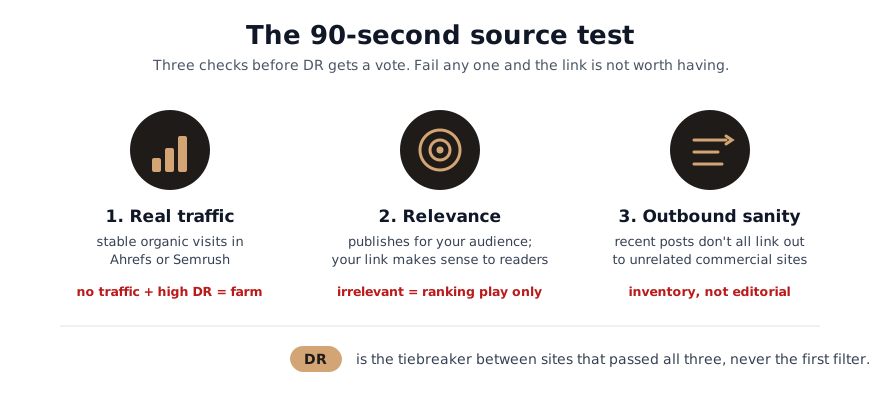
- Traffic: does the site have real, stable organic traffic in Ahrefs or Semrush? A site Google trusts gets Google traffic. No traffic plus high DR is the farm signature.
- Relevance: does this site publish for your audience, and would your link make sense to its readers? A relevant link is defensible forever; an irrelevant one is only ever a ranking play.
- Outbound sanity: open a few recent posts. If every article links out to unrelated commercial sites, you are looking at inventory, not editorial.
Only after those three does DR earn a vote, as a tiebreaker between sites that all passed. And the market data agrees authority is what you are really paying for when you pay: uSERP's survey of 800+ SEOs prices low-authority links around $300 and high-authority digital PR placements at $500 to $2,000. The spread between those numbers is the price of axis 3.
Axis 4: how the link got there (the 12 types you can actually build)
This is the axis you came for, because it is the only one you control. Below are the twelve acquisition types that survive contact with reality, each with what it costs (sourced), what Google has said about it on the record, how to get it, and a verdict.
The dollar figures come from the few primary sources that exist: Ahrefs' outreach experiment across 450 sites, Authority Hacker's survey of 755 link builders, uSERP's survey of 800+ SEOs, and Editorial.Link's pricing research. The broader numbers, each with its sourcing trail, live in the link building statistics library.
The scorecard first, then each type in depth:
| Link type | SEO value | Typical cost | Effort | Risk | Verdict |
|---|---|---|---|---|---|
| Editorial, earned via assets | Highest | Content production only | High | None | Build. This is the ceiling |
| Digital PR | High | $500-$2,000 per placement via agencies | High | Low | Build, if you have data or a story |
| Journalist requests | High | $0 | Daily habit | Low | Build, if you have real expertise |
| Niche edits (outreach) | High | $0 pitched, $361 average if bought | Medium | Low pitched, high bought | Build the free version only |
| Guest posts | Medium | $77.80 average fee when charged | High | Medium | Situational: audience, not anchors |
| Unlinked mentions | Medium-high | $0 | Low | None | Always on |
| Broken link building | Medium | $0 | High | None | Adjunct, not a program |
| Directories and citations | Low (real for local) | Free to cheap | Low | Low | Local: yes. Generic: no |
| Testimonials, badges, partners | Low-medium | $0 | Low | Low | Opportunistic |
| Forums, Reddit, comments | Near zero direct | $0 | Medium | Medium | For humans and AI answers, not link equity |
| Social profiles | Near zero | $0 | One afternoon | None | Day-one hygiene, then stop |
| Paid links and PBNs | Neutralized or negative | $83-$361+ per link | Low | High | Skip. The math fails before the risk does |
1. Editorial links you earned (the linkable asset play)
An editor or writer linked to you because your page was the best available thing to cite. Nobody asked, nobody paid. The whole industry agrees this is the best backlink there is, and the consensus is right, because this type maxes out all four axes at once: followed, in-content, from sites that chose you, at zero marginal cost per link.
You cannot build these directly, though. You build the asset and the links follow.
The assets that earn citations are predictable: original data nobody else has (surveys, internal usage stats, priced-out comparisons), free tools and calculators, and definitive reference pages that writers can cite in one line. When Authority Hacker surveyed 755 link builders, creating linkable assets was rated the single most effective tactic across the board, ahead of every outreach scheme in the survey.
How to get them: publish one citable asset per quarter rather than forty blog posts. Data beats opinion: a page titled "we analyzed X and found Y" gets cited because journalists need a number with a source. Then make the asset findable (rank it or promote it), because a citation can't happen to a page nobody sees.
Verdict: build. Slowest start, highest ceiling, compounds for years.
2. Digital PR
The industrialized version of earning editorial links: create a story journalists want (new data, a study, an expert angle on news), pitch it to publications, collect coverage with links. This is not a hypothetical tactic; it is the best-measured one on the list.
Digitaloft analyzed 500 campaigns across 114 businesses and found the average campaign earns links from 42 unique domains, at an average Domain Authority of 43, splitting 82% followed to 18% nofollowed. In uSERP's survey, SEOs rated digital PR the most effective link building tactic of all.
It is also the expensive end of legitimate link building: $500 to $2,000 per high-authority placement when you buy it as a service. The reason people pay anyway is arithmetic. One campaign averaging 42 linking domains, even at agency prices, lands the cost per link in the low hundreds, for links you could not buy individually at any price without crossing into spam-policy territory.
How to get them: the minimum viable version is one data story per quarter. Pull a finding from your own product data, a survey of your customers, or a public dataset nobody has cut this way. Write the press-style summary, build a media list of 50-100 writers who covered similar stories, and pitch short. If that is not a muscle you have, this is the one type where agencies earn their fee.
Verdict: build, if you have data or a story. Without one, you don't have digital PR, you have cold email.
3. Journalist request links
Reporters need expert quotes on deadline; platforms broker the exchange; the quote comes with a link. The platforms themselves have played musical chairs for two years, so here is the current state of things.
HARO, the original platform, was rebranded to Connectively by its old owner Cision and shut down in December 2024. A new owner bought it in April 2025 and relaunched it free under the classic name and email-digest format, then revived the Connectively brand for its fuller pitch platform: the product formerly known as Featured now lives at connectively.us. So today the pitchable platforms are HARO (free email digests), Connectively (the same company's platform version), Qwoted, Source of Sources (started by HARO's original founder during the shutdown), and Help a B2B Writer.
The economics: free, high-value when it hits (journalist links are editorial, in-content, from real publications), and brutally competitive since every SEO discovered it. Your response rate depends on whether you are a real expert answering inside your lane, fast, with something a writer can use.
How to get them: subscribe to two platforms and treat every request as its own brief, because they ask for different things. Some want a two-line quote; others want data, a worked example, a screenshot, or proof you have actually done the thing. Read what this specific writer needs, then lead with the one thing only you can provide: your numbers, your case, the lesson from doing the work. Match your length to the request, put credentials in one line at the end, and answer fast, ideally within the hour. Skip requests outside your lane; off-topic pitching trains writers to ignore you.
Verdict: build, if you have real expertise. A founder or practitioner can win these; an outsourced VA pretending to be one cannot.
4. Niche edits / link insertions
Getting your link added to an existing page rather than a new one. The honest version: you find a published article with a gap your resource fills, and you pitch the author the addition. The mechanism practitioners like: the page is already indexed and already has equity, so whatever the link passes starts flowing without the months a new post takes to earn its own standing.
This type has a split personality, and the split is the whole story. The pitched version is ordinary outreach. The bought version is the single most expensive link on the market: when Ahrefs asked 450 sites across nine niches to sell a link outright, the average asking price was $361.44, and only 12.6% of sites would sell at all.
A bought insertion is an unqualified paid link, which is link spam by Google's definition, on a page whose owner has demonstrated they sell to anyone. You are paying premium prices to stand in a heavily scrutinized spot.
How to get them (the clean way): search your topic, find ranking articles with an outdated stat, a dead reference, or a missing subtopic your page covers, and pitch the specific improvement: "your section on X cites a 2019 number; we published the 2026 version, here it is." Improvement-shaped pitches get read; "will you insert my link" pitches get deleted.
Verdict: build the free version only. The paid version is covered under paid links at the end of this list, because that is what it is.
5. Guest posts
You write an article for someone else's site and get links back. Guest posting carries a reputation as the safe, white-hat foundation of link building, and no type has a wider gap between that reputation and what Google has actually said.
Google's on-record position: a 2017 official warning against large-scale article campaigns naming keyword-rich anchors, mass placement, and thin content as link-scheme signals, then John Mueller in 2020 saying guest post links "shouldn't be passing signals" and should be nofollowed. Asked whether that includes the byline link: "Yes, even there."
Should you quit guest posting? No, and the same Google statements say why: writing for another site's audience is fine, encouraged even. What died is guest posting as a link-volume tactic.
The value that survives is real: you reach an audience that has never heard of you, you build the relationships that later produce editorial links, and yes, sites that respect their readers will often leave a relevant in-content link followed. Cost check for the "scale it" temptation: when Ahrefs pitched guest posts to 180 sites, about half the sites that responded wanted money, averaging $77.80, and a paid placement is just a paid link with extra steps.
How to get them: pitch sites your actual buyers read, one tier above your current reach. Send three specific title ideas that fit gaps in their existing content, write the piece better than their average, and link to yourself once, where it serves the reader, with a natural anchor. If your pitch would work with any site's name pasted in, it is spam.
Verdict: situational. Do it for audience and relationships, five great placements a year. As an anchor-text delivery mechanism, it is a 2013 tactic Google explicitly patrols.
6. Unlinked mentions and link reclamation
Someone already named your brand, product, or data in print without linking. The endorsement decision, the hard part of every other type on this list, already happened. You are asking for a formatting fix.
This is the highest-percentage outreach you can run, and it is nearly free. It also includes reclaiming links you used to have: mentions of moved pages, links pointing at URLs you killed in a redesign, your product name linked to a dead subdomain.
How to get them: set up alerts for your brand name, product names, founders, and any proprietary stat you have published (Google Alerts is free; Ahrefs Content Explorer with "highlight unlinked domains" is the power version). When a mention appears, thank the writer and ask for the link in two sentences. For reclamation, crawl your historical URLs quarterly and redirect or re-request anything pointing at a 404.
Verdict: always on. Fifteen minutes a week, indefinitely, for the cheapest real links you will ever get.
7. Broken link building
Find a dead link on someone's resource page, offer your page as the replacement, everyone wins. The logic is clean and the tooling is easy (any backlink tool lists a target's broken outbound links).
One honesty note before you build a program around it: no published study measures broken link building's actual success rate, so every percentage you see quoted for it is invented. The only adjacent measured number is for cold outreach in general, not this tactic: across 12 million outreach emails of every kind, Backlinko and Pitchbox found 8.5% got any response at all. A broken-link pitch carries a real favor, so it should do better than a generic ask, but "should" is not data. Plan with the general baseline and treat anything above it as upside.
How to get them: work backwards from your existing content rather than creating pages to fit dead links. Crawl resource pages in your niche, collect 404s that your existing pages could honestly replace, and send the short version: here is the dead link on your page, here is a live replacement, no pressure.
Verdict: adjunct, not a program. Run it when you find targets opportunistically; hiring someone to do this full-time is how you end up with a spreadsheet of nos.
8. Directories and citations
The type where one word ("directory") covers the best and worst links on this list, and only axis 3 tells them apart.
Generic web directories, the "submit to 500 directories for $49" kind, are named directly in Google's spam policies: "low-quality directory or bookmark site links." Dead tactic, and it has been dead since Penguin.
But two subspecies are alive.
Local citations (Google Business Profile, Yelp, Apple Maps, the structured NAP listings) remain a measured local ranking input: Whitespark's Local Search Ranking Factors put citations at 10% of local pack ranking signals in 2020, declining from roughly 15% in 2015 but still real, and their experts' consensus is that citations matter most for new businesses.
Genuine niche directories, the ones your industry actually uses (your trade association's member list, the review marketplaces your buyers compare tools on, a curated "agencies that do X" list with editorial standards), are legitimate because a human editor decides who gets in.
How to get them: for local, do the big platforms plus your city and industry listings once, correctly and consistently, then stop; a hundred citations do not beat twenty accurate ones. For niche, list every place your real competitors are listed and you are not (a backlink gap report shows this in minutes), then apply to the ones with editorial standards.
Verdict: local businesses, yes, foundational. Everyone else: the five to ten directories your industry uses, then never think about it again.
9. Testimonials, badges, and partner pages
The relationship-shaped links: you praise a tool you use and they quote you with a link; you win an award and embed the badge; your integration partner lists you on their marketplace page. Cheap, fast, legitimate, and structurally limited, because you only have so many real vendors and partners.
Two policy tripwires to step around. Google's spam policy prohibits "requiring a link as part of a Terms of Service, contract, or similar arrangement" without letting the linker qualify it, which is exactly what aggressive badge and widget programs used to do. And a badge program whose embed code carries a keyword-rich anchor is the widget-link violation with a logo on it. Branded anchors, qualified where appropriate, keep all of this boring and safe.
How to get them: list every tool you pay for and like enough to endorse; offer a testimonial to each (vendors actively want them). List every integration and partner relationship you have; check you appear on their directory or partners page. That is usually 10-30 legitimate links sitting in your existing contracts.
Verdict: opportunistic. Harvest what your real relationships already justify, then move on.
10. Forum, Reddit, Q&A, and comment links
Asked in 2021 whether forum posting still works as a link building method, John Mueller's complete answer was "No." These links are nofollowed or ugc-tagged nearly everywhere, Google has said it ignores links from user-generated-content sites because "they link to everything," and forum signatures with optimized anchors appear in the spam policy by name.
So why is this type on the build list at all? Because its value was never the link equity. The right way to run it: build these as if Google did not exist.
A helpful Reddit answer that mentions your tool sends actual buyers for years. Community threads now rank directly in Google and get quoted into AI answers, which means presence in them is distribution even at zero PageRank. The moment you catch yourself thinking about the link, you have lost the thread; readers and moderators smell it instantly, and the spam policy's parody pizza-guy is you.
How to get the value: answer real questions in the three communities where your buyers gather, mention your product only where it is honestly the answer, and measure referral traffic, not backlink counts.
Verdict: do it for humans and AI answers, never for link equity.
11. Social profiles and bookmarking links
Your Twitter/X bio, LinkedIn page, GitHub org, and the rest. Nofollowed, near-universal, and worth exactly one afternoon: claim them, complete them, link them home. They round out the brand's entity footprint and catch navigational searches.
What they do not do is rank you, and the "web 2.0 stacking" and social bookmarking schemes built on them have been publicly dead for a decade. Mueller in 2019: social bookmark links are "a really, really old SEO strategy" Google has "a lot of practice in recognizing... and just ignoring."
One vocabulary warning, since you will meet it while researching: sellers call these "pillow links," a term coined by the link-selling industry for padding that supposedly makes bought links look natural. The concept exists to sell you the padding. A natural profile does not need to be manufactured; it happens because real profiles accumulate this stuff anyway.
Verdict: day-one hygiene, then stop. Any vendor selling you volume here is selling links Google announced it ignores.
12. Paid links, link farms, and PBNs
Last, the type the rest of the article has been quietly pricing. The market is enormous and quantified: 74.3% of the 755 link builders in Authority Hacker's survey pay for links, at an average of $83 per placement, and Ahrefs' outright-purchase experiment averaged $361.44 per link. Private blog networks (networks of sites that exist to sell the links) and Fiverr-tier farms fill the bottom of the market at $2-4 a link.
Here is the case against, and notice it is economic before it is moral. Since Penguin 4.0 in 2016, Google's stated default for links it distrusts is devaluation, not punishment: it "devalues spam by adjusting ranking based on spam signals, rather than affecting ranking of the whole site."
In December 2022 it put an AI system on the job full time: SpamBrain now detects "both sites buying links, and sites used for the purpose of passing outgoing links," and when it does, "any credit passed by these unnatural links are lost" (Google's words, December 2022).
Read that as a buyer: the most likely outcome of a bought link is not a penalty, it is nothing, silently, while you keep paying. Manual actions still exist for egregious schemes, but the everyday failure mode is paying $83 to $361 for a link whose value was set to zero.
Then the second layer of loss, the one that never makes it into the pricing spreadsheet: the sites selling links die. Editorial.Link tracked 44,000 sites that were actively selling links in 2023; a year later, 29% of them returned an error. Nearly a third of that market's product ceased to exist within twelve months, taking the buyers' money with it.
And the legal version exists, which makes the illegal version even less defensible. Google's spam policy says buying and selling links is "a normal part of the economy of the web" and "not a violation" when qualified with sponsored or nofollow. So sponsor things: newsletters, podcasts, community events, tools your audience uses. You get the referral traffic and the brand lift, the link is qualified, and no algorithm ever has a reason to look at you sideways.
Verdict: skip. Not because you will be caught, but because the expected value is a neutralized link on a site with a 29% annual mortality rate. If you want to spend money on links, the same dollars buy digital PR, which earns the links Google actually counts.
Does your industry change the map?
You will see "SaaS backlinks" and "ecommerce backlinks" pitched as if they were species of link. They are not.
The honest version: the four axes are identical in every industry. What changes is which sources are available to you, and which foundation actually matters. The same twelve types apply; your business model changes the weights.
| Business model | Foundation layer | Your unfair advantage | The trap to skip |
|---|---|---|---|
| Local business | Citations and Google Business Profile (the one segment where directories are a ranking input) | Local press and community sponsorships: cheap, relevant links that get almost no pitches | National guest posting; DR-chasing outside your service area |
| SaaS | Niche and review-marketplace listings, integration partner pages | Your own product data as digital PR fuel; every integration is a partner-page link already paid for | Buying "SaaS guest posts" on DR-60 farms that write about everything |
| Ecommerce | Supplier, manufacturer, and "where to buy" listings | Product-led digital PR: gift guides, seasonal roundups, data from your sales patterns | Mass directory submissions and coupon-site spam |
| Content and affiliate sites | Entity basics only | Original data and free tools; you live or die on earned editorial links | Anything paid; thin sites get no benefit of the doubt |
If your industry is not on the list, derive your row the same way: your foundation is wherever your customers already look things up, and your advantage is whatever data or relationships you alone have.
The build order: which types to go after first
Knowing the types is the map. This is the route, and it depends on where you are starting from, not on which tactic sounds best in a blog post.
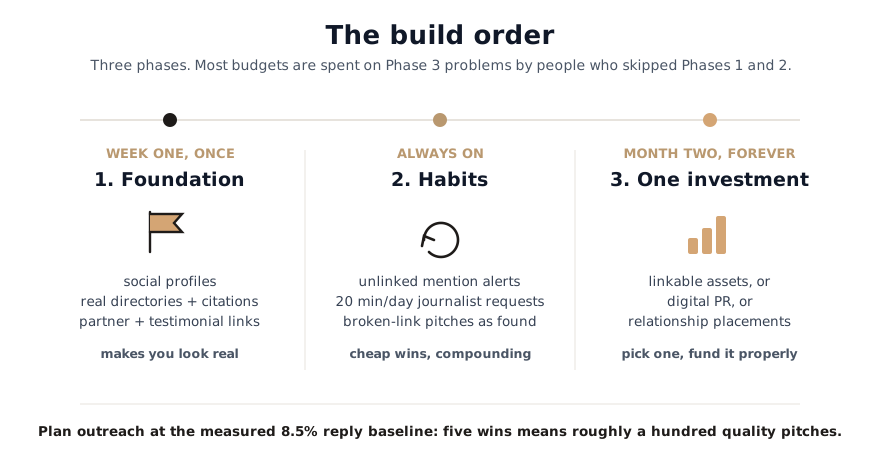
Phase 1, the foundation (week one, once, ever). Claim everything that requires no persuasion: your social profiles, the handful of directories your industry uses, local citations if you serve an area, and the testimonial and partner links your existing relationships already justify.
This layer will not rank you. It makes you look like a real business to every editor, journalist, and algorithm that checks, and it costs one focused day.
Phase 2, the habits (always on, from week two). Set up unlinked mention alerts and a quarterly reclamation sweep, run a 20-minute daily journalist-request routine if you have real expertise to offer, and send broken-link pitches when targets cross your path.
Budget the outreach math honestly: with an 8.5% baseline response rate, five wins means planning for something like a hundred quality pitches, not twenty. Treat that as a planning range to refine against your own numbers, because your relevance and pitch quality move it a lot in both directions.
Phase 3, the investment (from month two, forever). Pick one compounding play and fund it properly instead of running four half-heartedly: a linkable asset program if you have the content muscle, digital PR if you have data or a budget, relationship-driven guest placements and niche edits if your advantage is a network.
This phase is where the entire budget conversation belongs, because the first two phases cost almost nothing.
Starting from zero with no budget at all? The sequencing gets more delicate when you have no authority to trade on; the link building for startups guide is a separate playbook for exactly that position.
Links die. Plan for it from day one.
Getting the link is the halfway point, not the finish line, because links disappear, constantly, from every type on this list.
Pages get pruned in redesigns. Sites fold (a third of the link-selling market vanished in a year, and honest sites die too). Editors update old posts and drop your citation for a newer one. A migration nofollows a template and a hundred links change coordinates on axis 1 overnight.
This is why the four-axis map matters after the link goes live, not just before. Treat a link as an asset with a state, and the state changes: live or gone, followed or qualified, on a page that still ranks or one that got orphaned.
Every dollar figure in this article (the $77.80 guest post, the $361 insertion, the $2,000 PR placement) is the price of the link existing. When it drops, you do not get a refund or a notification. You just rank a little worse and never learn why.
So whatever mix of types you build, close the loop: keep an inventory of every link you earned, what it cost, and its current state, and check the state on a schedule. A spreadsheet works at 50 links and collapses somewhere before 500. Past that point the job needs software, and it is the exact job LinkWatchr exists for: it monitors every link you have built on the schedule you set and flags the day one goes missing or gets requalified.
Know the day a link dies
LinkWatchr checks every link you build and alerts you when one drops.
However you do it, do it. The most expensive backlink type of all is the one you paid for and stopped having without noticing. The full workflow for running that inventory is in the backlink management guide.
Start running the map
Memorizing type names changes nothing. What changes results: check every prospective link against four axes instead of one label, spend your money where the verified numbers point (assets and PR, not $83 placements), run the three-phase build order, and monitor what you build, because every type on this list shares the same failure mode of ceasing to exist without telling you.
Types of Backlinks FAQs
How many types of backlinks are there?
There is no true count, and any guide advertising an exact number gets there by counting synonyms. Backlinks classify along four independent axes: HTML attribute (4 defined values), page placement, source quality, and acquisition method (the twelve buildable types above). Multiply the axes and every "new" type you will ever read about is just a coordinate combination with a fresh name.
What is the single most valuable type of backlink?
A followed, in-content link, earned editorially, from a topically relevant site with real organic traffic. That is not a single type; it is the best value on each of the four axes at once, which is exactly the point of the map.
Are nofollow backlinks worthless?
No. They have been official "hints" since 2019, meaning Google may count them; 10.6% of backlinks to the web's top sites are nofollow, so a natural profile includes plenty; and a nofollow link from a page real buyers read sends you customers regardless of PageRank. Turn down a nofollow link from a good source and you have confused axis 1 for the whole map.
How much does a good backlink cost?
The verified market numbers: $83 average for a paid placement (Authority Hacker, 755 link builders surveyed), $361.44 average to buy a link outright (Ahrefs, 450 sites), $500 to $2,000 for high-authority digital PR placements (uSERP, 800+ SEOs), and $508.95 as the average price SEOs consider acceptable for one high-quality link (Editorial.Link). Earned links cost content and time instead of placement fees, which is why the linkable-asset play wins on cost per link at scale.
Do .edu and .gov backlinks carry special weight?
Nothing in Google's public documentation or on-record statements gives .edu or .gov domains special link weight. Those sites are often strong for ordinary reasons: old, trusted, heavily linked. Judge them on axis 3 like any other source, and skip the scholarship-page schemes invented to farm them; a fake scholarship is a paid link with tuition branding.
Should I disavow bad backlinks pointing at my site?
Almost certainly not. Google's default treatment of links it distrusts is to ignore them, and John Mueller has called toxic-link scores "made up by SEO tools so that you pay them regularly." His 2026 guidance: "The disavow file is a tool, not a religion. Most sites don't need it, but that's not all sites." Unless you actively built spam at scale or received a manual action, spend the time building instead.
Start monitoring today
Never lose a backlink again
Track every backlink automatically and get instant alerts the moment something changes.