Contextual Backlinks: The Five-Check Test Every Placement Must Pass
Written ByReviewed byUpdated


On this page
- What you are actually buying when you buy a contextual link
- The four conditions that make a link contextual
- Why "relevant body content" is not a test
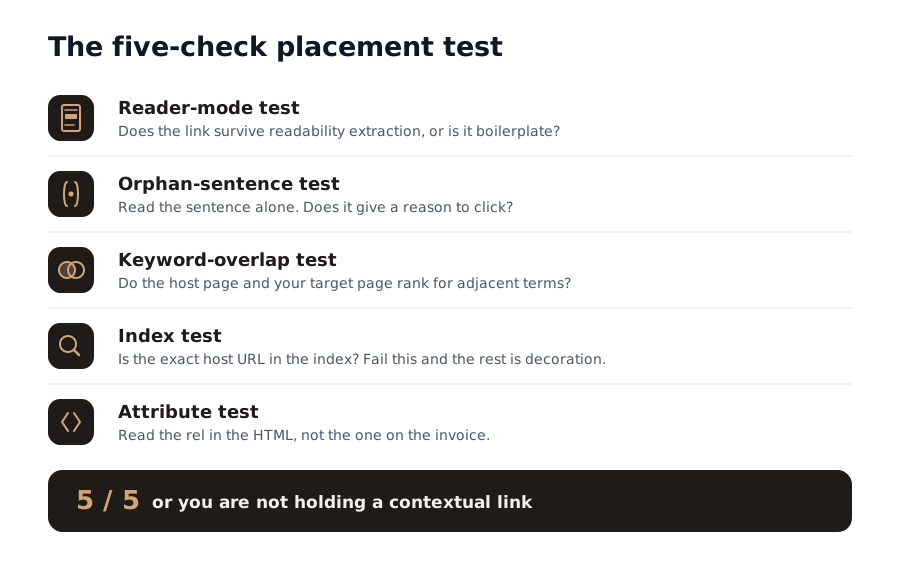
- The five-check placement test
- Check 1: the reader-mode test (position)
- Check 2: the orphan-sentence test (semantic support)
- Check 3: the keyword-overlap test (topical adjacency)
- Check 4: the index test (attribute integrity, part one)
- Check 5: the attribute test (attribute integrity, part two)
- Scoring it: accept, renegotiate, or walk
- Seven ways a contextual link stops being contextual
- The re-check cadence, and the honest split
- Where contextual links actually come from
- Original research and data assets
- Digital PR
- Journalist request platforms
- Niche edits and link insertions
- Guest posts
- Broken link building
- Podcasts and interviews
- Unlinked mention reclamation
- Anchor text: the number worth having
- What to do this week
An in-content insertion averages $361.44 to buy. A guest post with a bio link averages $77.80. Both numbers come from the same Ahrefs pricing experiment, and the gap between them is the entire market value of one thing: your link sitting inside a paragraph instead of underneath one.
So you are paying roughly 4.6x for a paragraph. Here is the part that should bother you. That paragraph belongs to someone else. They can rewrite it, move your link into a bullet list at the bottom, swap your anchor, or re-optimize the whole article for a different keyword next spring, and your link will keep returning a clean 200 status the entire time. Your monitoring will call it healthy. Your invoice will still say "contextual."
"Contextual" describes a relationship between your link and the words around it. Relationships change. Nobody hands you a way to check one, before you pay or after.
This guide is that check.
What you are actually buying when you buy a contextual link
Strip the term back and a contextual backlink is a link placed inside the running body content of a page whose subject overlaps yours, with anchor text that tells a reader what is on the other side.
That is the definition everyone agrees on, and it is correct as far as it goes. The trouble is that it describes a state, not an object, and it gets sold as an object. You do not receive a contextual backlink the way you receive a domain name. You receive a URL where, on the day of delivery, five separate conditions happened to be true at once.
Each of those five conditions is controlled by a different party:
| Condition | Who controls it |
|---|---|
| The link sits in the main content, not boilerplate | The publisher's editor and CMS template |
| The surrounding sentence gives a reason to click | The writer, and whoever edits the post later |
| The host page is topically adjacent to your target | The publisher's content strategy |
| The host page is in Google's index | |
| The link is followed, not qualified | The publisher's plugin settings and legal caution |
You control none of them. You bought a snapshot.
That framing sounds pedantic until you price it. Ahrefs' link rot study, run across 2,062,173 sites and updated in February 2024, found that 66.5% of all backlinks created since 2013 are now dead, and 74.5% are lost once you count errors and removed pages. The largest single cause is not the 404 everybody plans for. It is pages being dropped or removed entirely, at 47.7% of lost links. Linkody's survival analysis of the links it monitors puts roughly 8% gone inside three months and about 18% inside the first year.
Those figures describe outright death. The failure this guide is about is quieter and more common, and no study has measured it because it is invisible to every crawler: the link that survives perfectly while the context around it dissolves.
The four conditions that make a link contextual
Before you can test a placement you need the definition tightened into something falsifiable. Four conditions, and a link needs all four:
1. Position. The link is inside the primary content block of the page. Not the sidebar, not the footer, not the author bio, not a "you might also like" module, not a comment. Google's spam policies name footer links, template links, widget links, and comment links directly. The distinction Google keeps drawing is about how much editorial judgment stood between you and the placement.
2. Semantic support. The sentence containing the link explains why a reader would follow it. This is the condition that gets skipped most often, because it is the only one that requires reading.
3. Topical adjacency. The host page covers a subject that overlaps your target page's subject. Not the host domain, the host page. A DR 70 marketing blog is not topically adjacent to your dental practice because it happens to have published one post about small business websites.
4. Attribute integrity. The link is followed, on an indexed page, returning 200. Fail this and the other three are decoration.
Miss condition 1 and you have a footer link at an in-content price. Miss condition 2 and you have what the industry politely calls a placement. Miss condition 3 and you have a link that reads as manufactured to anyone who looks, including the systems built to look. Miss condition 4 and you have nothing at all.
Why "relevant body content" is not a test
Here is the practical problem with the standard definition: every condition above gets judged by eye, once, by whoever is holding the invoice.
A pattern shows up constantly in local SEO and agency circles, and one r/localseo thread captures it exactly. An agency buys a bundle described as 250+ contextual backlinks. The links arrive: real anchors, real body text, dofollow, on domains with respectable-looking authority scores. They are also dropped into posts about unrelated subjects, on sites whose metrics were built rather than earned. The buyer's instinct says something is wrong. The seller's reply is technically accurate on every point that can be checked quickly, because "these are contextual, they are in body text, they are dofollow and indexable" is a defensible sentence about a worthless link.
The buyer has no rubric. That is the whole failure. Not naivety, not a lack of tools. An absence of an acceptance test, on the most expensive line item in the link budget.
Compare it to anything else you buy at $361 a unit. You would have a spec. Link building has adjectives.
The five-check placement test
Five checks. Each one is binary, each names the tool, and each takes under a minute once you have done it twice. Run all five before you approve an invoice, and run three of them again on a schedule.
Check 1: the reader-mode test (position)
Open the host page in your browser's Reader View. Firefox and Safari both ship it; Chrome has it behind Distill or an extension. Then look for your link.
If your link is gone in reader mode, it lives in boilerplate.
Reader mode works by running a readability extraction that strips navigation, sidebars, footers, related-post modules, and promotional blocks to leave the article. That is approximately the same job search engines do when they separate a page's main content from its template furniture. It is a proxy, not a window into Google's actual boilerplate detection, and I want to be precise about that. But it is an objective, repeatable, free test for a condition that otherwise gets settled by squinting at a screenshot, and in my experience the failures cluster in one predictable place: a "Resources" or "Further reading" list at the very bottom of the post, which looks like body content in a screenshot and behaves like a link directory in reader mode.
For a batch, skip the browser. Run the host URL through a readability library (Mozilla's own readability package powers Firefox's implementation) and grep the extracted HTML for your domain. Twenty placements takes about two minutes.
Check 2: the orphan-sentence test (semantic support)
Copy the single sentence that contains your link. Paste it somewhere alone, with nothing around it. Read it.
Two questions:
- Does the sentence tell a reader what they will find on the other side of the link?
- If you deleted the link and left the sentence, would anything be lost?
A pass looks like this: "Ahrefs' link rot study, which tracked over two million sites, found that two-thirds of links created since 2013 are already dead." The sentence needs the citation. The link is load-bearing.
A fail looks like this: "There are many factors to consider when choosing a strategy for your business." The link could point anywhere. Nothing in the sentence commits to what is on the other end. That is a link the publisher inserted to fulfill an order, and it reads that way to a person, which means it reads that way to a system trained on people.
The second question matters more than it looks. If the sentence is complete and coherent without the link, the link is not supported by the context, it is merely adjacent to it. That is the difference between a citation and an insertion, and it is what everybody means by "natural" but nobody writes down.
Check 3: the keyword-overlap test (topical adjacency)
This is "relevance" converted from a vibe into a check.
Pull the top organic keywords for the host page URL in Ahrefs or Semrush (Site Explorer, exact URL mode, Organic Keywords). Pull the same for your target page. Look for a topical overlap.
You are not looking for identical keywords. You are looking for evidence that a reader who arrived on the host page via search plausibly wants what your page offers. A host page ranking for "how to choose a backlink monitoring tool" is adjacent to a target page about link tracking. A host page ranking for "best air fryer 2026" is not, whatever the domain's DR says.
Two useful outcomes when this check fails:
- The host page ranks for nothing. Not "nothing relevant," nothing at all. That is your strongest single signal that the page exists to hold links. Take it seriously even if reader mode, the orphan sentence, and the attribute all pass.
- The host page ranks well for a subject unconnected to yours. The placement will not hurt you much, but you are paying an in-content price for something that will never send a human being to your site and will never look like an editorial decision.
Do this at page level, always. Domain-level relevance is the loophole through which most irrelevant placements get sold.
Check 4: the index test (attribute integrity, part one)
An unindexed page passes zero value. There is no partial credit, no eventual credit, nothing to salvage. This is the check most worth automating because it is the one that changes without anyone touching your link.
Two ways to run it:
- Search Google for the exact URL. Not
site:domain.com, the full URL. If the page does not come back, it is not indexed. - Look the host URL up in Ahrefs. Zero keywords and zero traffic on a page that has been live for months is a strong indirect signal, and it doubles as the keyword-overlap check.
Run this at delivery and then on a cadence, because pages get pruned, noindexed during redesigns, and dropped by Google for thin content long after you paid.
Check 5: the attribute test (attribute integrity, part two)
Open the page source and find your href. Read the rel attribute that is actually in the HTML.
Not the one on the invoice. Not the one in the vendor's report. The one in the HTML, today.
You are checking for nofollow, sponsored, and ugc. Any of the three means the link is qualified, and that is a legitimate outcome you might have agreed to, but it needs to match what you paid for. Note that qualified links still carry real value as traffic and as brand mentions, which increasingly matters: Ahrefs' analysis of roughly 75,000 brands found branded web mentions correlate with AI Overview visibility about 3x more strongly than backlinks do (0.664 versus 0.218). A nofollowed mention in a real publication is not a wasted placement. It is just not the placement you were billed for.
While you are in the source, confirm two more things in the same glance: the anchor text matches what you specified, and the URL you are linked to is the one you asked for rather than a redirect or a stripped UTM-laden variant.
Scoring it: accept, renegotiate, or walk
Five checks, five points. What you do with the score:
| Score | Reading | Action |
|---|---|---|
| 5/5 | A contextual placement, verified | Accept. Log it, note the cost, set a re-check cadence. |
| 4/5, failing the attribute test | Right placement, wrong attribute | Renegotiate. A rel added by a plugin is often fixable with one email. Pay a qualified-link price or get it corrected. |
| 4/5, failing the orphan sentence | An insertion dressed as a citation | Renegotiate the copy. Publishers will usually adjust one sentence, and this is the cheapest fix on the list. |
| 4/5, failing reader mode | A resources-list link at an in-content price | Reject or reprice. Ask for placement inside a section. If the site's template cannot do that, this vendor is selling you a link directory. |
| 4/5, failing keyword overlap | Editorial placement, wrong audience | Judgment call. Fine as part of a diverse profile, bad as a pattern. Never pay a premium for it. |
| Failing the index test | Worth zero | Reject regardless of the other four. Do not pay for an unindexed page. |
| 3/5 or below | Not a contextual link | Reject. If a vendor delivers a batch that averages 3/5, the problem is the vendor. |
Two rules that make the scoring hold up in practice.
The index test is a gate, not a point. Fold it into the score and you let a 4/5 unindexed placement look acceptable. It is not acceptable. Score it separately and treat failure as fatal.
Score the batch, not just the link. One 3/5 in twenty is noise, and every honest vendor ships one occasionally. A vendor whose batch averages 3.4 has a process that produces 3.4, and next month's batch will too. The batch average is the number to track, and the number to put in front of the vendor.
Seven ways a contextual link stops being contextual
Everything above happens once, on delivery day. This is the part that keeps happening, and it is the reason to treat contextual placement as a state with an expiry rather than a purchase with a receipt.
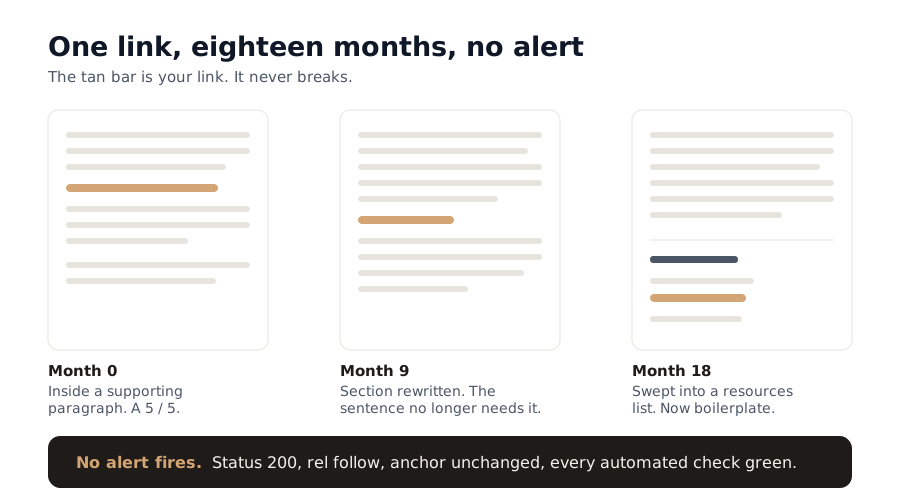
Each of these is something I have watched happen to links that a status-code check reported as perfectly healthy.
1. The paragraph gets rewritten. An editor refreshes a two-year-old post. The section holding your link gets rebuilt around a newer example. Your link survives the edit because deleting links is fussier than rewriting prose, so it lands in a sentence that no longer supports it. Your tool reports: live, dofollow, anchor unchanged. What is true: the orphan sentence now fails.
2. The link gets swept into a resources list. The most common form of quiet decay. A site redesign or an editorial cleanup consolidates outbound links into a "Further reading" block at the bottom of every post. Your link is intact, on the same URL, with the same anchor. It is now boilerplate. Your tool reports: live, dofollow, anchor unchanged. What is true: reader mode now fails, and you are holding a footer link that cost $361.
3. The anchor gets swapped. An editor normalizes anchors to house style, or a new SEO lead decides every outbound anchor should be the publication's preferred phrasing. Sometimes it becomes "click here." Sometimes it becomes a keyword you specifically did not want pointed at that page. Your tool reports: an anchor change, if it tracks anchors at all. Many do not.
4. A rel attribute gets added later, sitewide. This one arrives in batches. A publisher gets nervous about disclosure rules, installs a plugin, or hires a consultant who recommends qualifying all outbound links. Every link you have on that domain changes attribute overnight, months or years after purchase. Your tool reports: dofollow to nofollow, if it watches the attribute rather than just the status code.
5. The page gets deindexed while staying live. Thin-content pruning, an accidental noindex during a migration, a manual action on the host site, or Google simply dropping a page it no longer considers worth keeping. The URL returns 200 forever. Your tool reports: live and healthy. What is true: the link is worth nothing until the page returns to the index, and it may never.
6. The article gets merged and redirected. The host consolidates five thin posts into one pillar page and 301s the old URLs. Your link may have survived the merge. Frequently it did not, because merging is a rewriting job and rewriting drops links. A status check that follows redirects will report a clean chain and tell you nothing about whether your link exists on the destination. This is the failure mode most likely to be reported as a pass.
7. The host page drifts to a different topic. Slowest and hardest to catch. Over eighteen months of re-optimization, a post about email deliverability becomes a post about marketing automation software, because that is where the traffic was. The paragraph shell survives. Your link survives. Topical adjacency quietly evaporated somewhere in month nine. Your tool reports: nothing. What is true: topical adjacency now fails.
Read that list again with the pricing in mind. Every dollar you spent bought the existence of the link. Six of these seven failures leave the link existing.
Catch the change, not just the 404
Track status, attribute, and anchor on every link you build.
Start Monitoring
Free 14-day trial. No card required.
The re-check cadence, and the honest split
You cannot re-run five manual checks on 800 links every month. Nobody can, and any advice that implies otherwise gets ignored on contact. So split the work by what a machine can do and what it cannot.
What software checks well, on any cadence you want: status code, redirect behavior, rel attribute, anchor text, and index presence. These are the four failure modes with clean machine signals, and they cover the anchor swap, the late attribute change, the silent deindexing, and most merges.
What software does not check: whether the paragraph still supports the link, and whether the host page still covers your subject. The paragraph rewrite, the resources-list sweep, and the topic drift need a person to read the page. I have not seen a tool that does this honestly, and I would be skeptical of one that claimed to.
So the cadence has two layers.
Layer one, automated, tiered by value:
| Link tier | Cadence | Why |
|---|---|---|
| Links to money pages, and anything over ~$300 | Daily | These are the ones where a two-month detection lag costs real revenue. |
| Mid-tier editorial placements | Biweekly to monthly | High enough value to matter, stable enough not to need weekly. |
| Long-tail, directories, low-value historical links | Monthly to quarterly | Worth knowing about, not worth the checks. |
One point to be clear on, because it gets oversold across the category: a monitoring tool detects a change when it next crawls the link. If your project is on a monthly schedule, a link that dies on the 2nd surfaces on the 30th. Per-link cadence is a budget decision, and it is exactly the decision that flat-tier tools take away from you. It is the specific job LinkWatchr is built around: per-project scan schedules on credit-based pricing, so your weekly tier and your quarterly tier cost what they actually consume rather than forcing everything onto one frequency.
Layer two, manual, quarterly, top placements only:
Once a quarter, take your 20 to 50 highest-value contextual placements and re-run reader mode, the orphan sentence, and keyword overlap by hand. Reader mode, orphan sentence, keyword overlap. Budget an hour.
That hour is where you catch the resources-list sweep and the topic drift, which are the two failures that never trigger an alert and account for a large share of the value you quietly stop receiving. Every link you find is also a recoverable link, because a polite email to an editor pointing out that a citation got orphaned in a redesign has a much better response rate than a cold outreach pitch. You are not asking for a favor, you are reporting a broken thing on their page.
The full inventory workflow that layer one sits inside, including the fields worth tracking per link, is in the backlink management guide.
Where contextual links actually come from
The five checks are worth more once you know which acquisition methods tend to pass them. Below, each method with the procedure that works and the honest pass-rate expectation.
Two market conditions to hold in mind while reading. uSERP's survey of 800+ SEOs found 60% of businesses outsource link building, which tells you most of these placements are produced by someone whose incentive is delivery volume rather than your score. And the paid market prices in-content placement at that $361.44 average, which means every method below that earns placement instead of buying it is competing against a real number.
Original research and data assets
The highest pass rate of anything on this list, and the slowest to start working.
The mechanism: writers need citations. A writer with a claim to support goes looking for a number, finds yours, and links to it inside the sentence that makes the claim. That produces a 5/5 placement by construction, because condition 2 is satisfied automatically. The sentence needs your link. You did not negotiate the context, you caused it.
How to run it:
- Find a claim your industry repeats without a source. There is always one, usually a percentage that everyone attributes to everyone else.
- Produce the number honestly. A survey of 200 practitioners, an analysis of your own anonymized product data, or a structured audit of 100 sites all work. State the sample size and the date in the asset itself.
- Publish it as a citable page with the finding in an H2 and the methodology visible.
- Pitch it to the specific writers who have made that claim without a source in the last year.
- Set up alerts for unlinked mentions, because the second wave of citations arrives without a link and reclaiming those is the cheapest link building there is.
Expected score: 5/5 on the placements that land. Cost: real, in time or research budget. Caveat: most assets earn nothing. The distribution is brutally uneven and one asset carrying 80% of the return is normal.
Digital PR
Digitaloft studied 500 digital PR campaigns and 45,753 earned links: the average campaign earns links from 42 unique referring domains at an average Domain Rating of 41, with 82% followed and 18% nofollow.
Budget around that 18%. Journalists nofollow, and a journalist's nofollowed mention on a real publication is still one of the better things that can happen to you, both for referral traffic and for the branded-mention signal that correlates with AI visibility.
How to run it:
- Build a story, not an asset. A finding that surprises a general audience, not a guide that helps a specialist.
- Build the media list by hand from bylines on articles about your subject in the last six months. Databases produce lists; bylines produce responses.
- Pitch the angle in the subject line and the data in the first two sentences. Attach nothing.
- Follow up once.
- Check every placement against the five checks and expect a mix of followed and qualified.
Expected score: strong on position, semantic support, and indexation. Topical adjacency is the weak point, because general-audience coverage is rarely topically adjacent to a commercial page. Point PR links at your research and your homepage, not your pricing page.
Journalist request platforms
Connectively and its successors give you a queue of writers who have already committed to publishing something and need a source.
How to run it:
- Filter to the subjects you can speak to with authority. Answering outside them wastes the writer's time and yours.
- Answer within the first two hours. The queue is time-ordered in practice even when it is not in policy.
- Write the quote so it can be pasted without editing. Two or three sentences, one specific claim, no marketing language.
- Include your title, your company, and the exact URL you want linked.
- Track submissions, because publication happens weeks later and unlinked mentions are common.
Expected score: mixed. Quotes often land in the main content with a branded anchor, which passes position and semantic support cleanly. But a meaningful share of placements are bio-adjacent or nofollowed, and some publications strip the link entirely. Volume strategy, low cost per attempt.
Niche edits and link insertions
Asking a publisher to add your link to an already-published post. Ahrefs' figure for this is the $361.44 average. This is the method the five-check test exists for, because it is the one where the gap between a good placement and a sold placement is widest.
How to run it, and the vetting is the whole job:
- Find candidate pages by searching for your topic plus a phrase your target page could support, not by buying a vendor's inventory list.
- Run keyword overlap and the index test on the candidate page before you contact anyone. Does it rank for something adjacent, and is it indexed? This single step eliminates most of what gets sold as niche edit inventory.
- Read the paragraph you want to be in and write the sentence yourself. Send the publisher the exact sentence with the link in it. Publishers accept pre-written sentences far more often than they write good ones for you, and you get to control condition 2.
- On delivery, run all five checks before paying.
- Re-check at 90 days. This method has the highest rate of the resources-list sweep, because a site that sells insertions eventually consolidates them.
Step 3 is the slow one, and it is the step most people skip. Reading a 2,000-word article, deciding where a link could honestly live, then writing an insertion in the publication's own voice takes twenty minutes per prospect and does not scale by willpower. The AI Backlink Placement Finder extension does that loop on the page you have open: it quotes the exact paragraph to target, drafts the content to insert in the article's own tone and language, and proposes an anchor, along with the placement type it picked and why. Ten placements a month are free on a Google sign-in.
The fit check is what makes it useful, because it is the acquisition-side mirror of the orphan-sentence test. When the two pages only partly overlap it says so, and when they do not connect at all it tells you a link there would read as paid placement. A tool that will say "not here" is one you can believe when it says "right here," and an insertion you can send an editor pre-written is the single biggest change you can make to your accept rate.
Expected score: 5/5 when you sourced the page yourself and wrote the sentence. 3/5 when you bought from a list. That is the same tactic with the same name at the same price, and the score difference is entirely in step 2 and step 3.
Guest posts
$77.80 average, bio link included, which tells you what the market thinks a guest post link is worth relative to an insertion.
How to run it so it passes:
- Vet the host on the outbound-link test: open three recent posts. If every one links out to unrelated commercial sites, it is inventory, and your link will sit in a neighborhood that fails topical adjacency by association.
- Pitch a specific article the site is missing, with a working title and three section headings. Generic pitches get generic sites.
- Write the piece so your link is a citation inside an argument, not a mention in an intro. Put it in the section where it is the most useful next click.
- Take exactly one in-content link and let the bio link be a branded mention. Two or three self-links in one guest post is the pattern that makes an editor's SEO consultant flag the post.
- Verify against the five checks at publication, because editors edit.
Expected score: good on position, semantic support, and attribute when you wrote the sentence. Topical adjacency depends entirely on your vetting in step 1. Indexation is the one to watch, because guest-post-heavy sites have thin indexation.
Broken link building
Find a dead link on a relevant page, offer a live replacement.
How to run it:
- In Ahrefs, take a competitor or a well-linked resource in your space and pull Best Pages by Incoming Links, filtered to 404s. Those are dead pages with links pointing at them.
- Pull the referring pages for the dead URL. Those are your prospects, and each one has a broken link right now.
- Check that you have a replacement worth offering. If you do not, decide whether the pattern justifies writing one. Often it does, because one dead resource can have fifty referring pages.
- Email the specific page owner, name the broken link and where it sits on their page, and offer yours as a replacement in one sentence.
- Verify the fix. Some publishers remove the dead link without adding yours.
Expected score: high, and often 5/5, because you are replacing a link that already sat in a supporting sentence. The context was built for a citation, so you inherit condition 2. Caveat: low volume, and response rates fall off as the tactic ages.
Podcasts and interviews
How to run it:
- Target shows whose past three guests share your audience, not shows with the biggest download claims.
- Pitch a specific episode topic you can carry for forty minutes, with three things a listener will learn.
- Send the host a short bio and the exact URL you want in the show notes, before recording.
- Check the show notes page for main-content position and indexation after publication. Many show-notes pages are thin and poorly indexed, which is the usual failure here.
Expected score: middling on paper. Show-notes links are frequently in a template block, which fails reader mode, and many episode pages are barely indexed. Real value is the audience and the branded mention rather than the link, and it is worth doing for that.
Unlinked mention reclamation
The highest return per hour of anything on this list, and the least glamorous.
How to run it:
- Set an alert for your brand name, your product names, your founders' names, and the titles of any research you have published.
- Each week, filter to mentions with no link.
- Email the author. One sentence: they mentioned you, here is the URL if it is useful to readers.
- Log the ones that convert, because the authors who add a link once will do it again.
Expected score: typically 5/5, because the mention already sits in a supporting sentence in body content. Someone chose to write about you. You are only asking them to make the reference clickable.
Anchor text: the number worth having
Anchor distribution tables circulate with confident-looking ranges. Branded 40 to 50%, partial match 20 to 30%, exact match 1 to 5%. You will see these presented as thresholds.
They are practitioner heuristics, not published limits. Google has never released an anchor text ratio. Ahrefs' own anchor text research found a correlation between exact-match anchors and rankings while its guidance still points toward keeping exact-match low, and that tension is the honest state of the evidence. Use the ranges as a sanity check on a mature profile. Do not use them as a target, and do not calculate your way to a decision with them.
There is a more useful number, and it takes ten seconds to get: how many of your last twenty placements used the same anchor phrase?
Profile-wide percentages are dominated by history you cannot change and by links you never built. Recent batches are what you actually control, and repetition inside a batch is the specific pattern that looks manufactured, because that is exactly how it gets manufactured. A vendor working from a single anchor brief produces twelve near-identical anchors across twelve domains in six weeks. No profile-wide percentage will flag that while your total link count is healthy. Sorting your last twenty by anchor will flag it immediately.
Two practical rules that follow:
- Give vendors a list of five to eight approved anchor variants per target page, not one anchor and a keyword.
- When you write the sentence yourself, let the anchor be whatever the sentence needs. The best-performing contextual anchors are often descriptive phrases that contain no keyword at all, because that is what a writer citing a source naturally writes.
What to do this week
Contextual backlinks are worth what everyone says they are worth. The placement premium is real and the market price of $361.44 against $77.80 is the market agreeing. The standard advice gets the what right. What it never specifies is the verification, and what it never mentions is the maintenance.
Three concrete moves, in order:
- Score your last twenty placements. Five checks, twenty links, about ninety minutes. You will find at least one that is not what you paid for, and you will find out whether your current vendor's batch average is a 4.6 or a 3.2. That number changes your next purchase order.
- Put your top 50 links on a cadence. Weekly for money-page links, monthly for the rest, with the attribute and index checks running, not just status codes. The anchor swap, the late attribute change, and the silent deindexing stop being invisible the day you do this.
- Book one hour a quarter to read pages. Top 20 placements, reader mode and orphan sentence. This is the hour that catches the resources-list sweep, and it is the only way to catch it.
For the wider map of how in-content placement compares to every other link type you can build, and what each one is worth, see the types of backlinks guide. For the sourced data behind the decay numbers in this article, including the full link rot findings, see the link building statistics roundup.
Contextual Backlinks FAQs
What is a contextual backlink?
A contextual backlink is a link placed inside the main body content of a page whose subject overlaps yours, in a sentence that gives a reader a reason to follow it. Four conditions have to hold at once: main-content position, semantic support from the surrounding sentence, topical adjacency between the two pages, and a followed link on an indexed page. Fail any one and it is a link in body text rather than a contextual link.
Are contextual backlinks better than other backlinks?
Yes, when they meet all four conditions, and the market prices that premium: an in-content insertion averages $361.44 against $77.80 for a guest post with a bio link. The premium is only worth paying when you verify the placement. An unverified in-content link on an unindexed page is worth less than a nofollowed mention in a publication your customers read.
How do I check whether a backlink is really contextual?
Run five checks. Open the page in Reader View and confirm your link survives. Read the sentence containing your link alone and confirm it gives a reason to click. Compare the host page's ranking keywords to your target page's. Confirm the exact host URL is in Google's index. Read the `rel` attribute in the page source rather than on the invoice. Five out of five is a contextual link.
Can a contextual backlink lose its value without breaking?
Routinely. A paragraph gets rewritten around it, a redesign sweeps it into a "Further reading" block, a plugin adds `rel="sponsored"` sitewide, the host page gets deindexed while still returning 200, or the article gets re-optimized for a different topic over a year. In most of those cases a status-code check reports the link as healthy, which is why attribute, anchor, and index monitoring matter more than uptime checks, and why the position and relevance checks need a person on a quarterly pass.
Is buying contextual backlinks safe?
Paid links are against Google's spam policies, and the practical risk sits on a spectrum rather than a line. Buying a batch of 250 placements on domains with manufactured authority scores is the pattern those policies were written to catch. Paying a real publication for a placement you sourced, vetted, and wrote the sentence for is a different risk profile entirely. If you do pay, the five-check test is what separates the two, and the batch average is what tells you which one your vendor is actually selling.
How many contextual backlinks do I need to rank?
There is no threshold, and any specific number you are given was not measured. What the data supports is that quality dominates count: a handful of verified placements on relevant, indexed, trafficked pages consistently outperforms hundreds of unverified ones. The more useful question is how many verified placements your competitors have on the pages that compete with yours, which you can count in Ahrefs in an afternoon.
Do nofollow contextual links have any value?
Yes, just not the value you were billed for. Qualified links still send referral traffic and still register as branded mentions, and Ahrefs' analysis of around 75,000 brands found branded web mentions correlate with AI Overview visibility about 3x more strongly than backlinks (0.664 versus 0.218). Treat a nofollowed placement in a real publication as a win on a different axis. Treat a nofollowed placement you paid a followed price for as a billing error.
Start monitoring today
Never lose a backlink again
Track every backlink automatically and get instant alerts the moment something changes.