Link Building for Lawyers Without Getting Burned
Written ByReviewed byUpdated


On this page
You looked up the three law firms that outrank you for your practice area and city. Each one shows a few thousand backlinks, most from the same handful of legal directories, and two of those directories have already called you about a premium listing. Now you're wondering whether you need thousands of links to catch them.
Most of those directory links come from free profiles any licensed lawyer can claim. The paid tiers buy a better spot in the directory. Google's rules allow paid links only when they're tagged sponsored or nofollow. What separates the firms that rank is how many different sites link to them, and those you have to earn or pay for.
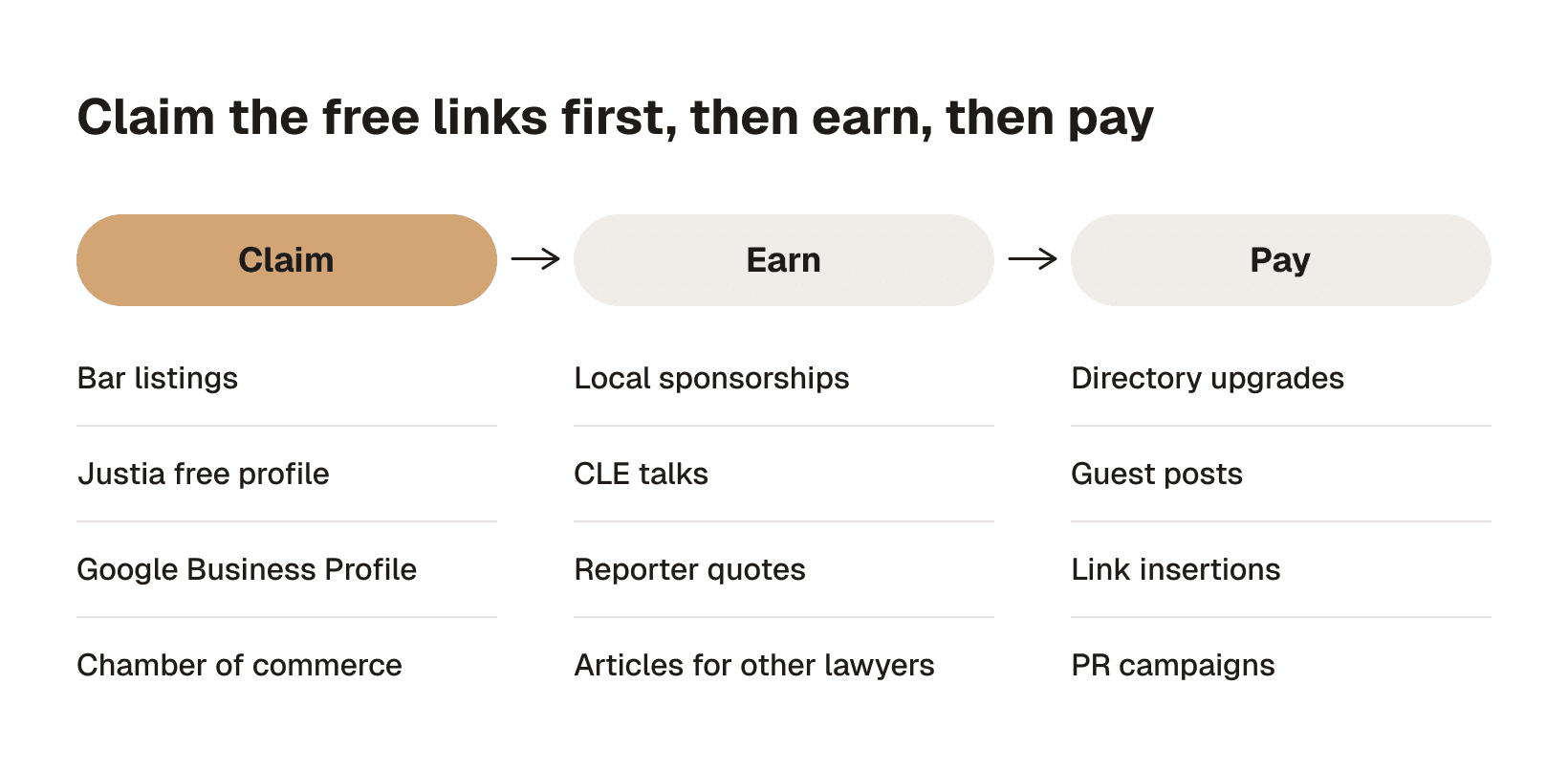
The order that works: find out whether links are what you're missing, claim the free listings, earn the links you can't simply buy, pay for the rest knowing a legal guest post runs $150 to $2,500 and up, and check that what you paid for stays live.
Does your firm need backlinks?
Most firms competing for a practice area in a city do need links, but far fewer than the number on your screen suggests, and sometimes the page is the problem. A backlink tool counts every page that shows a link to the firm. Legal directories and case-law sites show the same firm on listing pages, city pages, and case pages, so a handful of sites adds up to thousands of backlinks. A claimed Justia profile links to your website and blog, and the same claim lists you in the Legal Information Institute directory, a second site. Links also help a firm rank its own pages more than they help in the map results, which run mostly on the Google Business Profile.
So count sites, not links. Say one firm shows 3,000 backlinks from 40 sites and another shows 400 from 90. The second firm has the stronger profile. The comparison takes 15 minutes:
- Search "[practice] lawyer [city]" and open the top three firm sites.
- In a backlink tool with a free trial, open referring domains for each one, not backlinks.
- Remove legal directories, case-law sites, and social profiles. What's left is the sites that chose to link to them.
- Do the same for your own site.
- Put your practice page next to theirs and compare length, attorney bios, and local detail.
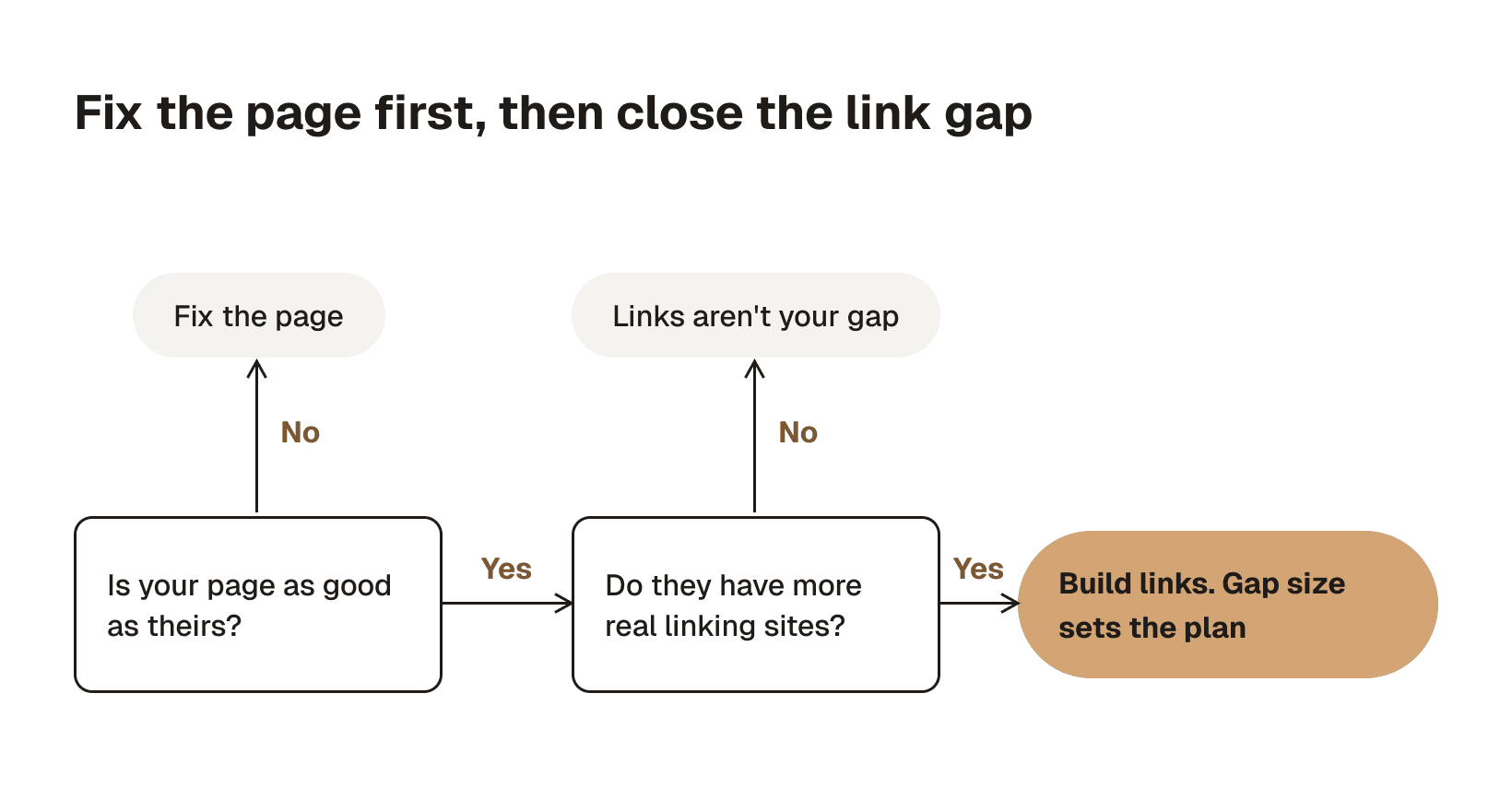
If your practice page is thinner than theirs (a few hundred words, no attorney bio, no local detail), fix it first. Links pointed at it won't move it. If it holds up and they have more real linking sites, the gap sets the plan: under 20 more sites is a few months of local links, 20 to 100 is six to nine months, and over 100 is a year or more. If you already match them, look at the page, your reviews, and your Business Profile instead. If you're already in the top three, keep claiming and earning, and don't buy.
Judge any link, free or paid, on five checks:
- Same practice or same city. A family-law blog in your state beats a general business site.
- The host page gets real visitors. A page nobody reads passes little and sends no one.
- The link sits in the content, and you know its type: followed,
nofollow, orsponsored. A link in the article text beats one in a footer or sidebar, and a contextual backlink is worth most when the sentence around it gives readers a reason to click. - The site isn't part of a network. A group of sites built to sell links can lose every link at once.
- The site doesn't sell to everyone who pays, especially a rival in your city. A "write for us" page with a price list means your link is worth what everyone else's is.
Claim the free listings
Every firm starts the same way: claim every free listing for the attorneys in your firm, in your state and city. One afternoon covers them all.
- State and local bar directories. Member pages often link to the firm's site, so ask what your dues already include.
- Justia. Any licensed attorney can have a free, full-featured profile.
- Google Business Profile. It links your site and drives the map results, so fill in every field.
- Chamber of commerce and local business groups. Member pages link to member sites.
Check Avvo, FindLaw, Lawyers.com, and HG.org for a free profile too, and claim any that exist. Keep your firm name, address, and phone number identical on every listing.
A paid tier buys position. On Justia, premium placement buys priority on listings pages, removes competitor ads from your profile, and adds analytics. Premium listings run from free to well over $1,000 a year, according to Constellation. Super Lawyers selection is free to view, and its advertising is sold separately. Stay on the free tier for a quarter, put a separate tracking phone number on the profile, and upgrade only when the calls it sends cover the fee. If the free profile sends no calls in a quarter, an upgrade won't fix that.
To see what link a listing gives you, open the profile, right-click the link to your site, choose Inspect, and read the rel attribute. A browser extension that highlights nofollow links does the same job faster. A paid listing with a followed link is a paid link to Google. A nofollow link still sends visitors and calls.
Earn the links you can't simply buy
The links that move rankings for a local firm come from places that don't sell links: your town, your bar, reporters, and other lawyers.
- Sponsor something local: youth sports, charity runs, legal-aid clinics, bar events. The money buys the sponsorship and the link comes with it, so ask the organizer to link your site from the sponsor page, not just print your name. At local scale these rarely draw attention, and a link tagged
sponsoredstill brings local calls. - Speak at a CLE or bar program. The event page links your bio, so make sure the bio on your firm's site is the one you want read. Offer one talk on a question from your practice area that other lawyers run into with their own clients.
- Ask for the link where you're already named. Search your firm and attorney names without your own site, and set a news alert. When a page names you without a link, email the editor the exact URL and the page you'd like linked.
- Answer reporters. HARO is a free newsletter of reporter queries, sent three times a day and run today by Featured. Qwoted and Source of Sources also match experts with requests. Reporters on legal stories need a quotable attorney fast, so answer within the hour, only in your practice area, two or three a week. A quote in a local or trade outlet often links your bio.
- Write for other lawyers: bar journals, JD Supra, the National Law Review, and non-competing firms in other states. A rival across town won't host your byline, but a colleague in another state often will.
- Go on legal podcasts. The show notes link your site. Pitch one topic you can talk about for 30 minutes.
- Publish something other lawyers cite. Other lawyers link to a page that saves them an hour: local accident data, a court-filing walkthrough, plain-English statute explainers.
- Run your practice-and-city query in AI search and add the sources it cites to your list.
- Skip the scholarship page. Schools prune pages built for links, and the money does more as a local sponsorship.
Say you're a solo family-law attorney in a mid-size city with up to $150 a month and four hours a week. A directory salesperson pitches a premium upgrade, and you buy it. The divorce page doesn't move, because the profile link came free and the page had nothing worth linking to. Instead, claim every free listing in an afternoon, rewrite the divorce page with fees and process, answer two reporter requests a week, give one CLE talk, and sponsor one local event a quarter. A few new linking sites a quarter means it's working. If no reporter replies in six weeks, move that time to articles for lawyers in other states.
Is paying for links allowed?
Google and your state bar look at a paid link for different reasons, and passing one tells you nothing about the other.
Google's link spam policy bans buying or selling links for ranking and allows paid links tagged rel="sponsored" or rel="nofollow". A tag is one word in the link's HTML that tells Google not to count the link for ranking. Google has said it got significantly better at detecting and nullifying link schemes built on sponsored and guest posts, and that sites with excessive untagged ones can face algorithmic and manual actions.
The industry buys links anyway, law firms included, and most of what's sold as "links" comes untagged. Google can't see a payment, and a site that sells links also gives real ones. So the realistic risk is that bought links stop counting, or that a whole site's links get discounted. What draws attention is scale and obvious patterns across many links: the same hosts, the same exact-match anchors, sudden spikes such as a firm with 30 linking sites adding 20 in a month. Careful operators keep volume modest, hosts varied and relevant, and anchors mostly the firm or attorney name. Never repeat "car accident lawyer [city]" across sites.
What your bar checks
ABA Model Rule 7.2(b) bars giving anything of value for recommending a lawyer, with an exception for the reasonable cost of advertising. The ABA rules are a model; states adopt their own versions, and yours is what applies.
UK, Canadian, and Australian firms have their own directories and regulators.
Pay for the rest with prices in hand
Legal links cost more than the same link types in most industries because one case can be worth five or six figures, and sellers price against that. Lawyer Link Building publishes these ranges for legal placements.
| Link type | Range |
|---|---|
| Guest post | $150 to $400 small sites, $400 to $900 mid, $900 to $2,500 and up established |
| Link insertion | 20 to 40 percent below a guest post on the same site, $100 to $600 for most usable sites |
| Digital PR | $2,500 to $8,000 a month per campaign, two to twenty links, some none |
| Managed retainer | $2,000 to $10,000 a month, and below about $1,500 the links have to be cheap ones |
A legal guest post runs $150 to $2,500 and up, depending on the host. An insertion on the same site runs 20 to 40 percent less. To compare quotes, divide the monthly price by the placements you get.
Never buy a placement blind. If you buy a link, make sure it pays back. Whether it's tagged sponsored, nofollow, or a followed link with no tag matters less than two things: the link is relevant, and the practice page it points at brings in calls, cases, or rankings. Buy only from a site that passes the five checks, at a price inside those ranges, pointing at a practice page you can name. Compare the price with what one more case from that page is worth, and skip the link if the numbers don't add up. The quoted fee is only part of the cost: finding the site, writing, outreach, and replacing dead links are the rest.
| They say | What it means |
|---|---|
| "8 links a month at DR 50+" | A guest-post package. Ask for hosts; check your monthly link pace. |
| "Niche edit" or "link insertion" | A link added to an old article. Ask its age, traffic, outbound links. |
| "Marketplace placement" | Cheap network inventory. Ask for the host list. |
| "Our network" or "aged domains" | A private blog network (PBN) on expired domains. Skip it: caught, every link goes. |
| "Digital PR campaign" | Priced per campaign. Ask what counts as a result if the count is low. |
| "Toxic link audit and disavow" | A cleanup sold on fear. Skip it. |
| "Citation building" | Bulk business listings: consistent details, little ranking value. |
Put these in the contract:
- The host list before signing. Check each host's DR free with the DR in SERP extension.
- No network or PBN sites.
- An expected placement count and a live URL for every placement, so you can see what you bought.
- A replacement if a link drops or never gets indexed.
- Exclusivity in your city and practice area, so the same host list isn't sold to a rival.
- Your firm keeps its own logins for its domain, Business Profile, and directories.
In the US, the FTC says a paid article must not pass as anything other than an ad, and where a label is needed it has to be clear, in plain words like "Ad" or "Advertisement". Most paid guest posts in this market run with no label.
Say you're an in-house marketer at a 12-lawyer personal-injury firm with two quotes. A is $4,000 a month for five to seven placements, about $570 to $800 a link. B is $1,200 a month for 15 links "on DR 50+ sites", $80 a link, under $1,500 a month and at a price where a site claiming real traffic should make you suspicious. You ask both for 10 sample hosts and spend two hours on each list running the five checks with a backlink tool trial and Google. Most of B's sites have a high DR and almost no search traffic. Several write about everything, post a "write for us" price list, and carry authors with no trace elsewhere. A site: search on one sample post returns nothing, and another host already sells to a firm across town. Two of B's hosts pass, seven of A's. You take A, drop the three failures, check that each remaining placement points at a practice page whose calls could cover $570 to $800, and put the host list, count, replacement, and exclusivity terms in the contract. A seller who won't share hosts gets a no.
Plan on two to four good links a month. Rankings take three to six months to move in a mid-size market and six to twelve in a big-city personal-injury market, depending on how hard the market is. Do it yourself if you have four or more hours a week; link building with no budget runs on the free listings and earned links above. Hire once the budget clears about $2,000 a month, and expect to split the work: the firm handles sponsorships, speaking, and reporter answers, and an agency handles outreach.
Check that the links you paid for are still there
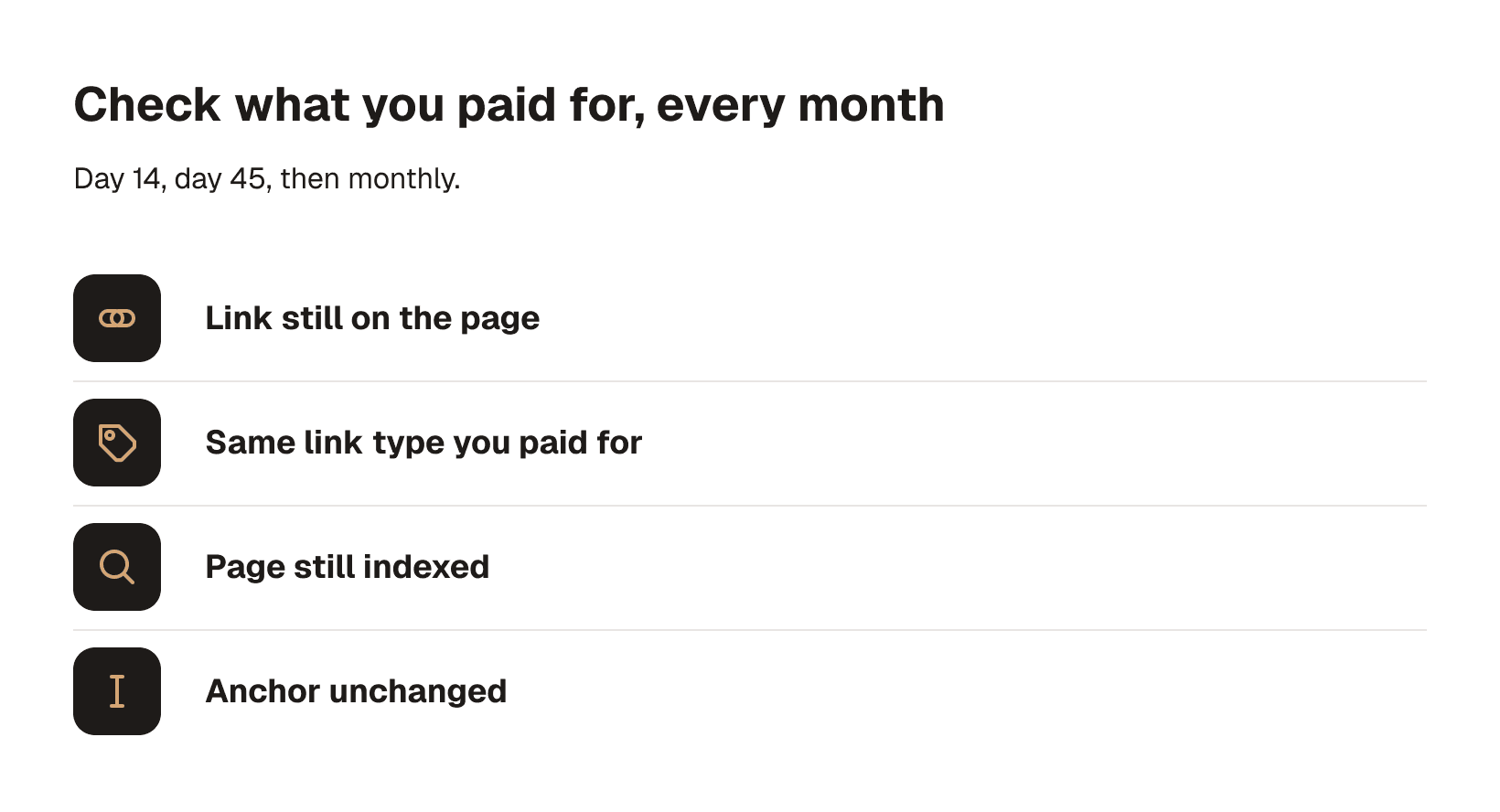
A link you paid for can disappear, change type, or drop out of Google, and nobody emails you when it happens. Five things go wrong:
- Removed by the publisher, often in an article refresh.
- Changed from followed to
nofolloworsponsoredafter the publisher updates its policy. - Dropped from Google's index, so the link passes nothing.
- Lapsed with a premium directory tier, which takes its links with it.
- Never placed, though the report says it was.
Check at day 14 and day 45, then monthly, and put both dates on the calendar the day a placement goes live. Open each URL and look at the link itself, because a seller's report that lists a placement isn't proof it's there. A link not live by day 14 is a credit, not a delay, and any link still missing at day 45 gets a replacement request that week, with the URL and the date it was last live.
Each month, count the new linking sites that would pass the five checks, see where your target practice page ranks for "[practice] lawyer [city]", and note the calls and forms that page produces. If linking sites grow and the page hasn't moved after three to six months (longer in a big-city personal-injury market), check the page before buying more.
Keep one list for managing your backlinks: live URL, host, price, date, the link type you paid for, and the anchor.
If you're building or buying links and want to keep them, use LinkWatchr to monitor them. Add the pages your links sit on, pick daily, weekly, or monthly checks, and it alerts you by email or Slack when a link is removed, changes type, gets a new anchor, or its page drops out of Google's index. Agencies keep each firm in its own workspace.
Free listings can lose their link or change its type just as quietly as paid placements, so check the bar listing as closely as the most expensive placement.
Keep the links you build and buy
Monitor them with LinkWatchr on a schedule you set.
Start Monitoring
Free 14-day trial. No card required.
Frequently asked questions
Should I disavow spammy links pointing at my firm's site?
Almost never. Spammy links you didn't build are mostly ignored, and a "toxic link audit" is a product being sold. Disavow when you bought links and now have a manual action from Google. Otherwise the hour is better spent claiming a listing or answering a reporter.
Should we hire a legal marketing specialist or a general SEO agency?
Specialists know the legal hosts and charge for it. A general agency can do the same work if it agrees to the same contract terms: hosts before signing, a placement count, live URLs, and exclusivity in your city. Ask either one for a reference from a firm in a different city.
Is law firm link building really different from other industries?
Higher prices, more paid directories, the bar's advertising rules on top of Google's, and local links that count for more than national ones.
What happens to our links if we stop paying the agency?
Placements bought outright usually stay up unless the publisher removes them. Links from a premium directory tier, rented placements, and network sites tend to disappear. Ask before signing which links stay after the contract ends, and run the monthly check for a quarter after you leave.
Start monitoring today
Never lose a backlink again
Track every backlink automatically and get instant alerts the moment something changes.