Link Building for SAAS and What a Program Costs to Run
Written ByReviewed byUpdated


On this page
- Why link building for SaaS is different
- Which pages to build links to first
- Why editors won't link to your product page
- Five ways to get links to pages that sell
- The links a SaaS company can get, from free to paid
- Set up your G2, Capterra, and Trustpilot profiles
- Get listed on integration and partner pages
- Turn unlinked brand mentions into links
- Get into the comparison lists buyers read
- When to buy niche edits and guest posts
- Use your product data for digital PR
- Are directories, exchanges, and paid links worth it for SaaS companies?
- How to find prospects and pitch them
- Find prospects with a competitor backlink gap
- An outreach email you can adapt
- What SaaS link building costs
- Link prices by method
- What $2,500, $5,000, and $10,000 a month buys
- Should you hire an agency or keep it in-house?
- How long before link building moves your rankings
- Keeping the links you build
- How SaaS links feed AI answers
- Where to start this week
Your homepage and blog collect the links. The comparison and product pages that close deals sit with almost none, and every editor you pitch would rather link to a blog post than to anything with a pricing button on it.
Link building for SaaS is the work of fixing that: earning links that move the pages that make money, from the sites and listings your buyers already check. The pages editors refuse to link to can still get links. Below is how operators get them, with the emails to send and what each link costs at 2026 prices.
The short version:
- Pick a short list of pages close to revenue.
- Earn links with what you own: review profiles, integration pages, listicle entries, your product data.
- Buy selectively, for relevance, not DR.
- Agency retainers start around $2,500 a month, so below that, run it yourself.
- Check every link on a schedule and judge the program at 90 days.
Why link building for SaaS is different
A SaaS site makes its money on a handful of commercial pages, and those are the pages links rarely reach. ClearBrand describes a common pattern: links pile up on the homepage and blog posts while the product, comparison and integration pages that close deals have few of their own. Three things change the work:
- The results you need to beat are other people's pages. Search "best [category]" or "[competitor] alternatives" and page one is review sites and listicles. You have to appear on those pages, not only rank above them.
- Buyers check integrations and reviews before they book a demo. Those pages get opened early, and AI answers draw on the same places.
- The owner is rarely a link building team. It is one part-time marketer plus a freelancer or an agency, which is why the program has to be a short list of pages and not a long list of tactics.
Which pages to build links to first
Point your first links at comparison pages, then integration pages, then product pages, and let the homepage collect links on its own. Keep the list under ten pages. For each candidate, ask four questions:
- Is it one click from a demo or signup?
- Does it rank on page one or two but below the top five?
- Do the pages above it have clearly more linking sites?
- Would an editor link to it without feeling they ran an ad?
A page that fails the first question is supporting content: it earns links and passes them on with internal links. A page that fails the last one needs one of the workarounds below. Search Console gives you the rankings, and Ahrefs or Semrush gives you the linking-site counts for the pages above you.
Why editors won't link to your product page
Editors treat a link to a product page as free advertising. LinkBuilder reported what site owners said when it pitched a client's tool page:
"site owners repeatedly told us they'd rather link to a blog post than to the photo editor tool page, because linking to a product felt like running an ad."
The result is links that go to the blog and rarely reach the page that sells. A pitch that says "please link to our pricing page" gets ignored.
Five ways to get links to pages that sell
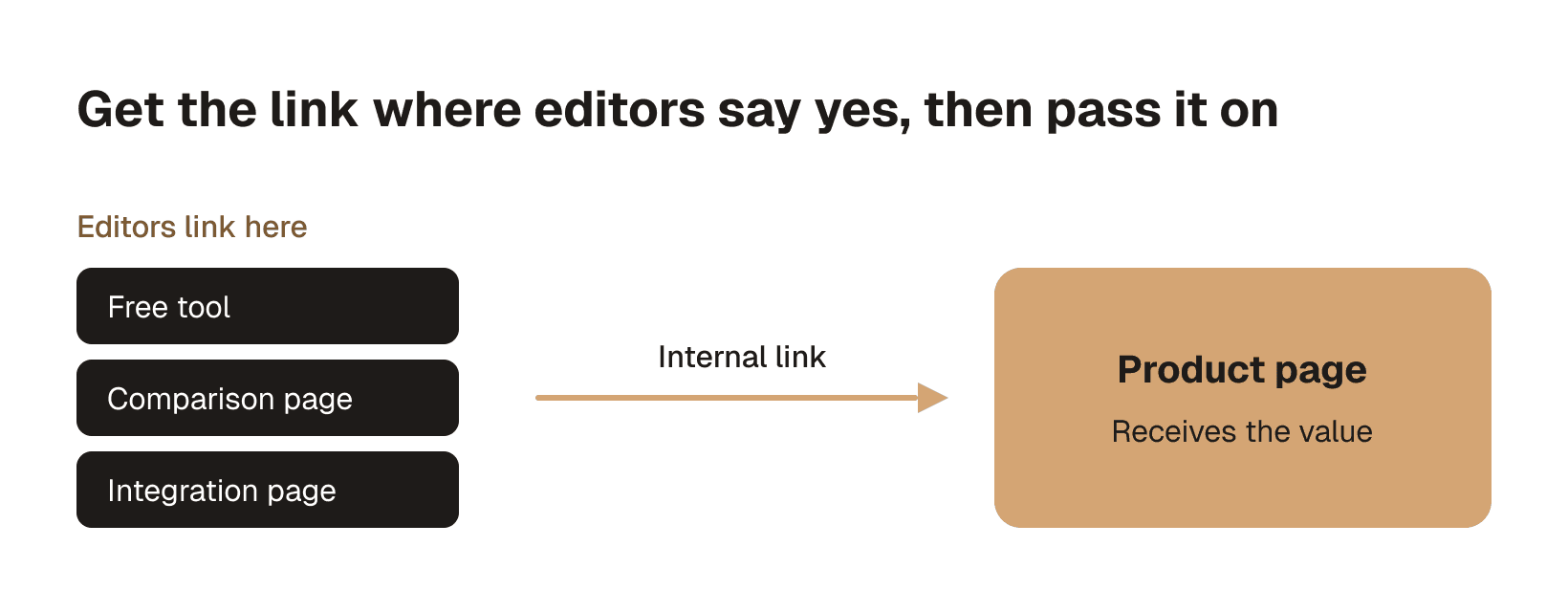
Give the editor something to link to that is not a sales page, then move the value to the page that sells.
- A free tool at or next to the product URL: say you sell invoicing software, and a free invoice template generator one click from the product page earns links from "how to invoice clients" articles. It costs engineering time and fails if nobody searches for the tool. With no engineering time, use the next two.
- The integration or partner page: list the integration in HubSpot's marketplace, point the listing at your integration page, and pitch writers covering HubSpot workflows. It needs the partner to agree, which is a partnerships conversation, not an outreach list.
- The comparison or alternatives page: writers updating "[competitor] alternatives" lists will link a page that lays out the differences, including the competitor's strengths. It fails when it reads as a sales sheet.
- Supporting content plus internal links: a benchmark post earns the links, and a contextual link in its first 200 words sends the value to the product page. It is the slowest of the five.
- An addition to an existing article: send a one-line note pointing to the exact section where your product already fits. It gets the highest reply rate and the smallest win per link.
The links a SaaS company can get, from free to paid
Most SaaS programs run five or six of these at once, and the first three need no outreach budget at all. Which types of backlinks are worth building depends on what you own, and a SaaS company owns more than it thinks.
| Tactic | Cash cost | Time cost | Best target page |
|---|---|---|---|
| Review profiles | Free | An afternoon, then ongoing review requests | Comparison pages |
| Integration pages | Free | A week of back-and-forth | The integration page |
| Unlinked mentions | Free | An hour a week once alerts are set | The page the article is about |
| Listicle entries | Free, or a placement fee | 20 to 40 minutes per pitch | Comparison or product page |
| Niche edits and guest posts | Paid per link | A few hours to vet and brief | Comparison or integration page |
| Digital PR | A campaign budget or staff time | Four to eight weeks per data study | A data page that links onward |
| Broken-link and resource-page replacement | Free | About an hour per dead URL | Comparison or alternatives page |
For the last row, watch for SaaS tools that shut down or get acquired. Pull the backlinks of their dead pages in Ahrefs or Semrush and pitch your page as the replacement on the "best X" lists and resource pages that still link to them.
Say you are a founder with no budget and five hours a week. Work review profiles, integration listings, unlinked mentions, and one podcast a month: the cash cost is zero, and the first links land inside two to three weeks.
Set up your G2, Capterra, and Trustpilot profiles
Review profiles are usually nofollow and still among the most valuable pages a SaaS company can own. Product marketing usually owns them, so hand them this list:
- Claim the profile.
- Pick the categories that match your comparison queries.
- Add screenshots and current pricing.
- Ask customers for reviews right after an onboarding milestone, and ask them to name specifics.
- Link the profiles from your comparison pages and keep the claims on both consistent.
Add SaaSHub in the same pass.
Get listed on integration and partner pages
An integration page is a link both companies want to exist.
- List in the partner marketplace: Zapier, HubSpot, Slack, or Salesforce, whichever your customers run.
- Publish your own integration page with setup steps and screenshots.
- Ask the partner to link it from their docs or integrations directory.
- Propose one co-marketing post to their team.
Turn unlinked brand mentions into links
Unlinked brand mentions are the cheapest links you will get. Set up Google Alerts or Ahrefs Alerts on your brand and product names. When a mention turns up without a link, send two sentences:
Subject: Thanks for the mention in [article title]

Hi [name], thanks for including [brand] in [article]. Could you link the name to [URL] so readers can find it?
Send one follow-up after a week, then drop it.
Get into the comparison lists buyers read
"Best [category]" and "[competitor] alternatives" articles are where buyers shortlist, so an entry there beats any blog link. Search both patterns for your category, sort by last-updated date, and pitch the ones refreshed in the past year. Lead with what the list is missing: a feature, a price point, a screenshot. Some of these sites ask for payment for an entry, which makes it a paid placement.
When to buy niche edits and guest posts
Buy placements on existing pages when you need speed, but know what the cheap supply is. Insertions go into aged pages that already rank, so they move faster than a new post. "SaaS guest posts" are a product category: vendors list placements on sites that exist to publish them. BuzzStream's pricing analysis found that only 1.37% of 257,267 guest post sites met its quality bar.
Before you pay anyone, run three filters: the editor rejects some pitches, the site has an audience, and the article is not published elsewhere too.
Use your product data for digital PR
Digital PR is the one tactic that earns links without asking for each one. A data story is citable when it has one surprising number, a chart writers can embed, and a one-paragraph method. Send it to the 20 to 30 writers who covered the topic in the past year. A survey with no surprising finding is not a story.
Podcasts cost founder time, not cash. Pitch the host one episode idea built on your data story, and ask for the show-notes link to the page it covers. Pick shows by audience fit: a 2,000-download show your buyers hear beats a 50,000-download general business show.
Are directories, exchanges, and paid links worth it for SaaS companies?
Directories are a base layer, exchanges and paid links are a risk you size, and careful operators use all three.
Directories. A new domain gets its first links from startup and software directories, an afternoon of submissions, and founders still before product-market fit should start there.
Exchanges. A few swaps with partners you overlap with are normal, and they differ from a swap network. Google names excessive link exchanges as link spam, so keep them few, relevant, and in body copy.
Paid links. Buying is normal practice. In Editorial.Link's survey of 518 SEOs, 91.9% believe their competitors buy backlinks and 63.1% would place links on sites that sell links if the quality were right. Google's rule is that buying links for ranking is link spam unless the link carries rel="sponsored" or rel="nofollow", as its spam policies state. The realistic downside is money spent on links that stop counting, and in the worst case a manual action that costs more than the links did.
Careful buyers avoid the footprints: the same anchor over and over, bulk orders from one marketplace, sitewide footer links, and a sudden spike of new links. They buy relevance and real traffic over DR, take links in body copy, and spread orders across vendors and months. In the US, a placement readers can't tell is paid needs a disclosure under advertising rules, and plenty carry none, which is a risk the buyer takes on.
How to find prospects and pitch them
Your best prospects already link to the three pages outranking yours.
Find prospects with a competitor backlink gap
Run the gap per target page, not per domain.
- Open Ahrefs Link Intersect or Semrush Backlink Gap and enter the top three URLs ranking for the page's query, with your page as the one to compare.
- Keep the sites that link to two or more of them but not to you.
- Vet each site for topical match, real traffic, and a link that would sit in body copy, using the five checks for whether a placement counts. DR is a filter, not the decision, and the free DR in SERP extension shows it while you browse results: 500 new-domain checks a month signed out, 500 a day signed in.
- Sort what is left by which sites already have an article your page fits.
Source-request platforms like HARO are opportunistic. Answer when a request matches something you know, and do not build the program on them: journalist inboxes are flooded, and reply rates are poor.
An outreach email you can adapt
Pitch an addition to an article they already have, not a new post.
Subject: [Their article title]

Hi [name],

Your [article] lists [tool A] and [tool B] for [job]. We built [product], which [one specific difference], and our [comparison page or free tool] covers [the question their readers ask]. If it fits, one line in your [section] section would give readers a third option. I can send a screenshot or a data point if that helps.
Three rules keep it working:
- Name the exact section the line would go in.
- Give one reason a reader benefits, not a reason you want the link.
- Follow up once after five to seven days, then move on.
What SaaS link building costs
Average link prices run from $179 for an insertion to $1,250 to $1,500 for a digital PR link, so budget by method, not by an average.
Link prices by method
Each method has its own price, and the spread is wide.
| Method | Average price |
|---|---|
| Link insertion | $179 |
| Direct guest post | $295 |
| Vendor guest post | $461 |
| Agency editorial link | $600 to $1,500, as uSERP quotes it |
| Digital PR link | $1,250 to $1,500, or $5,000 to $10,000 per campaign for about six or seven linking domains |
Expect to pay above these averages, and toward the top of each range, for sites your buyers read. Published agency retainers run $2,500 to $10,000 a month, and the competitive tier that includes SaaS runs $3,000 to $10,000.
What $2,500, $5,000, and $10,000 a month buys
Each tier buys a different mix, and the first 90 days should produce the same evidence at every level: links live and indexed, and the target pages moving. Work out the return on link building by putting a signup or demo value on each target page before you pick a tier.
| Monthly budget | Pricing it assumes | Months 1 to 3 | At 90 days |
|---|---|---|---|
| $2,500 | About four agency editorial links a month at the $600 low end of the uSERP quote, $2,400 | Links to two comparison pages and one integration page | About 12 placements live and indexed |
| $5,000 | Three to eight agency editorial links a month at $600 to $1,500 | Months 1 and 2: links to comparison and integration pages. Month 3: that month's $5,000 goes into a digital PR campaign | Placed links live, and the campaign's first pickups in |
| $10,000 | $30,000 a quarter: up to $10,000 for one digital PR campaign, and the other $20,000 (about $6,700 a month) for four to eleven editorial links a month | One campaign shipped, plus editorial links to every target page | The campaign's links checked, and steady placements on every target page |
Say your 25-person project management SaaS has one content marketer, $2,500 a month, comparison pages ranking 8 to 14, and no engineering time. The first plan was ten cheap marketplace guest posts pointed at the homepage. Domain rating rose and nothing that sells moved. The second plan runs like this:
- Month 1: write the page list (two comparison pages, one integration page), fix the G2 and partner listings, place the first four editorial links.
- Month 2: place four more, and check that month 1's links are live and indexed.
- Month 3, the 90-day check: place the last four. About 12 placements are live and indexed, both comparison pages are up, and impressions are rising.
- Months 4 to 6: keep the vendors whose links held and drop the rest. If sites won't take a comparison-page link, pitch the integration page.
- Months 6 to 12: check whether the comparison pages have reached the top 5.
Should you hire an agency or keep it in-house?
Your budget decides it more than your team does.
- Under $2,500 a month: run it yourself, with occasional bought placements.
- $2,500 to $5,000: hire a freelancer or small agency aimed at named pages.
- Above $5,000 on competitive terms: hire an agency with SaaS editorial relationships, briefed with your page list and judged on page movement.
Whoever runs it, keep your own record of every link. A report should list every placement and show how each target page moved. Reject one built on average DR and link counts.
How long before link building moves your rankings
Expect first movement on mid-ranking pages in about three months and durable rankings on hard terms in 12 to 24. Judge the links early and the rankings later.
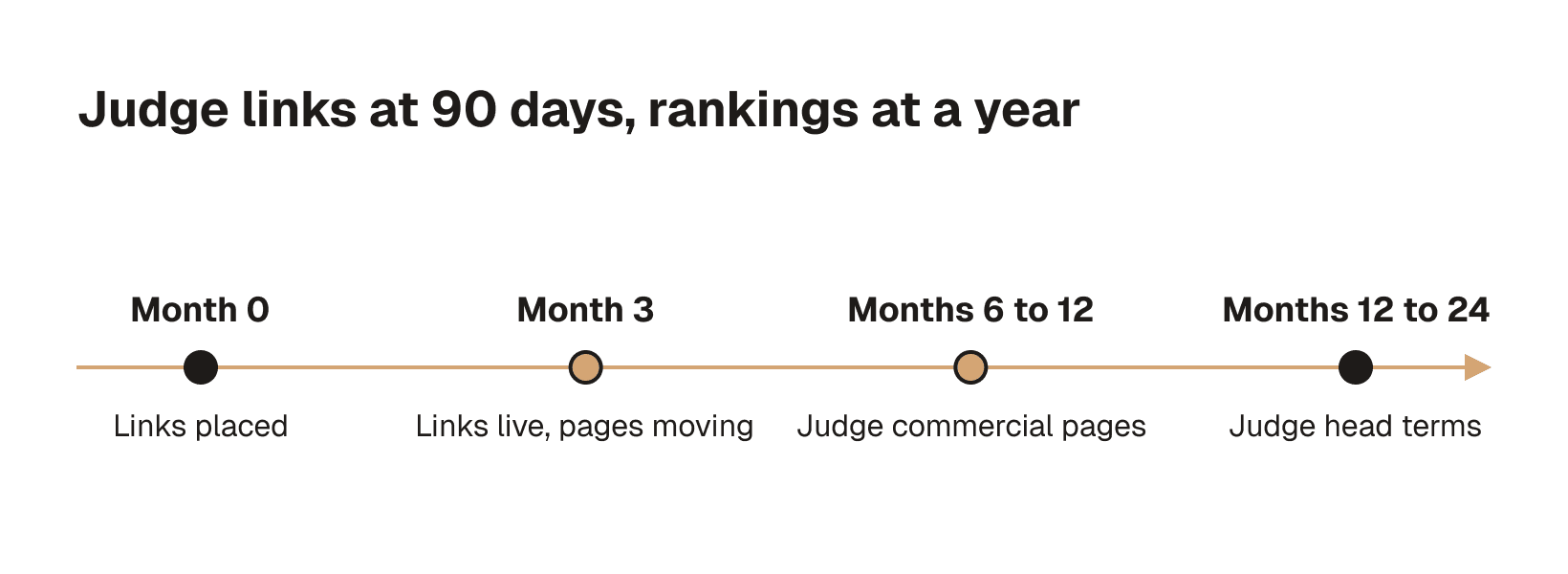
Expectations run ahead of that: in Editorial.Link's survey, 57.1% of SEOs expect results within one to three months. That fits a page already sitting at 8 to 14. It does not fit a head term: LinkBuilder's two published SaaS campaigns each ran about 23 months.
At 90 days, check that:
- The links are live and indexed.
- The target pages are moving up.
- Impressions are rising on those pages.
- The first links from review and integration listings are in.
At month 12, ask:
- Are the commercial pages in the top 10?
- Are signups or demo requests from those pages rising?
If links are live at six months and the pages have not moved, fix the page, not the link count.
Keeping the links you build
A link you paid for can disappear without anyone noticing until rankings slip. Five things take links away:
- Removed in an editorial refresh: the host rewrites the article and your sentence goes.
- Flipped to nofollow: a redesign or a new site policy tags outbound links.
- Anchor rewritten: the editor tidies your agreed anchor into something else.
- Linking page dropped from the index: the link is still on a page Google no longer holds.
- Listing removed after a plan change: a review or partner listing vanishes when a partner changes plans or a profile lapses.
A spreadsheet records each link and never re-checks it, so the sheet keeps saying live. Picture an agency running eight SaaS clients from one spreadsheet. A placement bought for one client is flipped to nofollow in a site redesign. Nobody re-checks, and the client's target page slides from 4 to 9 over two months. The client spots it first. A scheduled check on every placement, with the vendor and contact stored next to the link, gives the account manager an alert at the next check and the contact to email that day.
Check on this cadence:
- The day a placement goes live: link present, follow status, anchor, page indexed.
- Weekly for the first 90 days: paid placements and insertions, the links most likely to be edited.
- Monthly: earned editorial links, review profiles, integration and partner listings.
- After a partner's plan change or a host site's redesign: every link on that site.
- Quarterly: target-page movement and which vendors' links survived. Stop buying from the ones whose links dropped.
Record the vendor, price, contact, date live, target page, and anchor for every link.
Once a placement goes live, LinkWatchr checks the linking pages you add: whether the link is still there, dofollow or nofollow, on an indexed page, with the anchor you agreed on, on a daily-to-monthly schedule you set per project. Custom columns you set up hold that record for every paid placement, so it sits next to the check. Workspaces keep each client's links separate, with view-only access for anyone who just needs to see the proof.
Measure the target pages, not link counts or DR. Report where each page ranks and how many signups or demo requests it sends, and treat the link record as the explanation when a page moves. That habit is the base of running a link profile over time.
Know a link dropped before your client does
Start Monitoring Your Links
Free 14-day trial. No card required.
How SaaS links feed AI answers
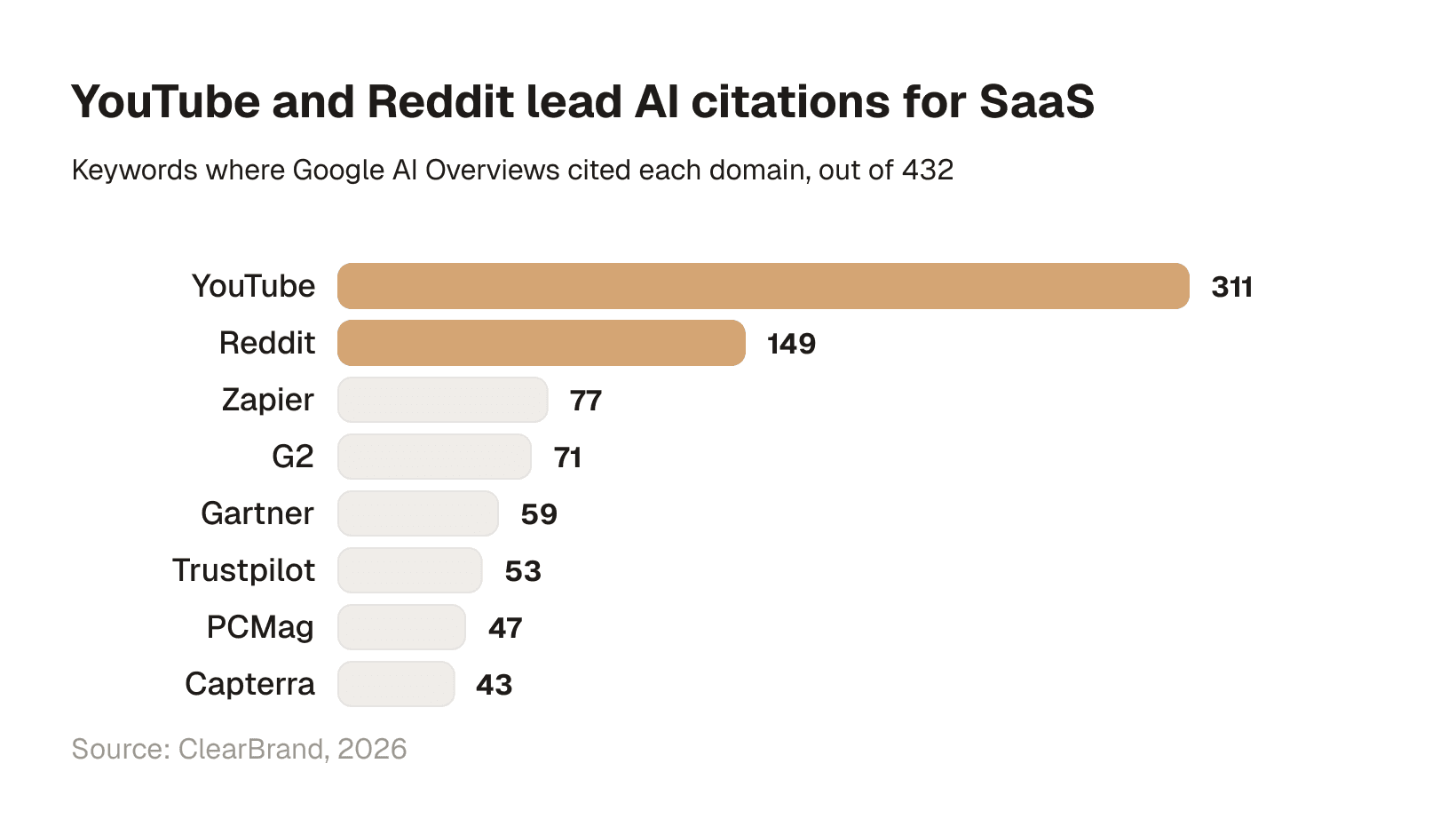
Links still decide rankings, but most AI Overview citations for SaaS queries go to sites outside the organic top 10. In ClearBrand's study of SaaS buyer keywords, only 36.3% of citations pointed to a domain that also ranked in the top 10 for that keyword. These domains were cited most, by how many of 432 keywords they appeared on:
Links and mentions both matter here. Ahrefs' study of 75,000 brands found that branded web mentions correlate 0.664 with AI Overview brand visibility, against 0.218 for raw backlink count. So the profile that feeds AI answers is wider than a blog link profile, and each surface gets one action:
| Surface | One action |
|---|---|
| YouTube | Publish a walkthrough of each integration and each "[you] vs [competitor]" comparison. |
| Answer threads where buyers ask for tools, from a named account. Planted praise gets spotted and downvoted. | |
| Zapier and integration marketplaces | Complete every listing, as in the integration steps above. |
| G2, Capterra, Trustpilot | Complete the profiles and collect recent, specific reviews. |
| Gartner | Collect reviews on Gartner Peer Insights in your category. |
| PCMag and editorial reviewers | Pitch for inclusion when they refresh "best [category]" roundups. |
Where to start this week
Start with the pages, then the links you can get without a budget.
- Pick your pages (two hours): open Search Console and a backlink tool, run the four questions, and cut the list to under ten.
- Fix your review and integration listings (an afternoon): complete the G2, Capterra, and Trustpilot profiles and the partner marketplace listings.
- Pitch the three listicles ranking for your category (two hours): use the outreach email above.
- Put every placement on a check schedule from day one, and book the 90-day review in your calendar before the first link goes live.
Frequently asked questions
Is link building worth it for a SaaS company?
On competitive commercial terms, yes: the pages that rank for "best X" and "X alternatives" carry far stronger link profiles than the pages below them. A new category or brand-led queries can rank on content alone, so check the link gap on your target pages first.
How many backlinks does a SaaS site need?
There is no site-wide number, so set it per page. Take the gap in linking domains between your page and the pages above it and spread it evenly: a page twelve domains behind gets one or two new ones a month, not twelve in a week. Once it holds a top-three spot, move new links to the next page on your list.
What anchor text should SaaS links use?
Mostly your brand name, the URL, or a natural description. Google lists keyword-optimized anchors in guest posts and press releases as link spam, and repeated exact-match commercial anchors are a footprint careful buyers avoid.
What should you ask a SaaS link building agency before signing?
Ask the price per placement and what counts as one. Ask for the named target pages the links will point to. Ask what happens when a link is removed or flipped to nofollow within an agreed number of months, and who owns the editor relationships if you leave.
Start monitoring today
Never lose a backlink again
Track every backlink automatically and get instant alerts the moment something changes.